

The reward-and-rebound cycle, food addiction research, and what genetics can and can't tell you.
Dopamine gets called the brain's "pleasure chemical" so often that most people think a food either gives them a dopamine hit or it doesn't. That description is incomplete, and it matters for anyone trying to understand their own relationship with food. Dopamine is more accurately involved in wanting, learning, anticipation, and the drive to pursue a reward.1 Liking, the actual pleasure of eating, runs on a different, overlapping system. A person can want a food intensely with almost no memory of enjoying the last ten times they ate it. That gap between wanting and liking is a big part of why "I know better" doesn't reliably stop the behavior.
This article covers what food actually does to dopamine signaling, why some foods are described as more rewarding than others, the genetic variants that appear to shift a person's vulnerability to reward dysregulation, and why none of that genetics adds up to a diagnosis or a life sentence.
QUICK REFERENCE
- How Dopamine Affects Food Cravings: Wanting vs. Liking
- Do "Dopamine Foods" Work? Tyrosine, Protein, and the Basics
- Why Highly Processed Foods Can Trigger Stronger Cravings
- The Dopamine Reward-and-Rebound Cycle
- Stress, Emotional Eating, and the Nervous-System Connection
- Dopamine Genes, SNPs, and Food Cravings: What We Know
- Is Food Addiction Real? Symptoms, Science, and Limits
- How to Respond to Food Cravings Without a Dopamine Detox
- Can You Have Withdrawal-Like Symptoms From Processed Foods?
- When Food Cravings Need Professional Support
- FAQs
- Unanswered Questions?
- Discussion
How Dopamine Affects Food Cravings: Wanting vs. Liking
Someone can walk past a bag of chips they don't even particularly enjoy anymore and still feel a pull to open it. That pull is dopamine doing its job. It flags a cue as important and motivates action toward it, independent of how good the food will actually taste.1 This is why cue exposure (the smell from a restaurant, the sight of a familiar wrapper, a stressful moment that used to end in a specific snack) can trigger a craving that has very little to do with hunger.
Do "Dopamine Foods" Work? Tyrosine, Protein, and the Basics
Dietary tyrosine and phenylalanine are the amino acid precursors the body converts, through several enzymatic steps, into L-DOPA and then dopamine.2 Foods containing these amino acids, fish, poultry, meat, eggs, beans, lentils, soy foods, nuts, seeds, and dairy for those who tolerate it, supply that raw material. So does adequate overall protein intake, along with cofactors like folate, vitamin B6, iron, copper, vitamin C, magnesium, and zinc, all involved in catecholamine metabolism.
It's worth being precise about what this does and doesn't mean. A protein-rich meal doesn't generally produce the same fast, highly reinforcing sensory-and-reward response that a candy bar's combination of sweetness, texture, fat, and flavor can produce. Protein-forward, fiber-rich, minimally processed meals appear to support more stable energy availability and steadier blood sugar, which may reduce the intensity of reward-driven eating over the course of a day. A nutrient deficiency can impair normal catecholamine synthesis, but taking a supplement on top of an otherwise adequate diet does not reliably "raise" dopamine in a way that changes eating behavior. The honest framing is that these foods support the conditions for normal neurotransmitter synthesis and steadier eating patterns, not that they deliver an immediate neurochemical boost.
Why Highly Processed Foods Can Trigger Stronger Cravings
A single nutrient doesn't define the foods most likely to strongly activate the brain's reward circuitry. They're usually engineered combinations of refined carbohydrate, added sugar, fat, salt, and concentrated flavor, formulated to be easy to eat quickly and unusually reinforcing. Candy, pastries, sweetened cereal, sugar-sweetened beverages, chips, fries, and many fast-food combinations fall into this category. Researchers increasingly use the term hyperpalatable rather than "junk food," because it points to the actual mechanism. These foods can deliver a lot of energy quickly while offering less fiber, protein, volume, and chewing than a minimally processed meal, and that combination can make it easier for some people to keep eating before fullness catches up.
You'll see foods like this described online as "highly dopaminergic," but that's internet shorthand, not a clinical or nutrition term. "Highly palatable" or "highly reinforcing" gets closer to what's actually happening. Whatever you call it, the label doesn't make a food dangerous, immoral, or off-limits, and it doesn't mean everyone who eats it will develop a problem. It means the sensory and post-ingestive properties of that food are unusually reinforcing, especially under stress, sleep loss, restrictive dieting, trauma activation, depression, or food insecurity. I know they are for me, you can read about what this looks like for me with my CPTSD.
I want to be equally direct about the flip side. I don't use the term "dopamine-depleting foods," and I'd encourage you to be skeptical of anyone who does. That framing implies a specific food drains a fixed store of brain dopamine, which isn't established in humans. The research supports something more nuanced and more useful. Repeated, frequent exposure to highly rewarding, ultra-processed foods appears to be associated with changes in reward learning and reward sensitivity over time in some people.3 A donut doesn't "use up" your dopamine for the day. A pattern that repeats itself, on the other hand, can reshape what your brain treats as rewarding.
The Dopamine Reward-and-Rebound Cycle
This pattern tends to move through a recognizable sequence, and naming it can be more useful than any single fact about dopamine.
- A highly rewarding food produces a fast reward signal, and it may also relieve stress, fatigue, boredom, or emotional discomfort in the moment.
- That relief gets learned. The brain files the association that this food, this fast, works.
- A crash, renewed hunger, guilt, or a stronger next-time craving often follows.
- Some people respond with restriction or self-criticism, resolving to be "good" tomorrow.
- Restriction and stress both increase vulnerability to repeating the cycle, and it starts again.
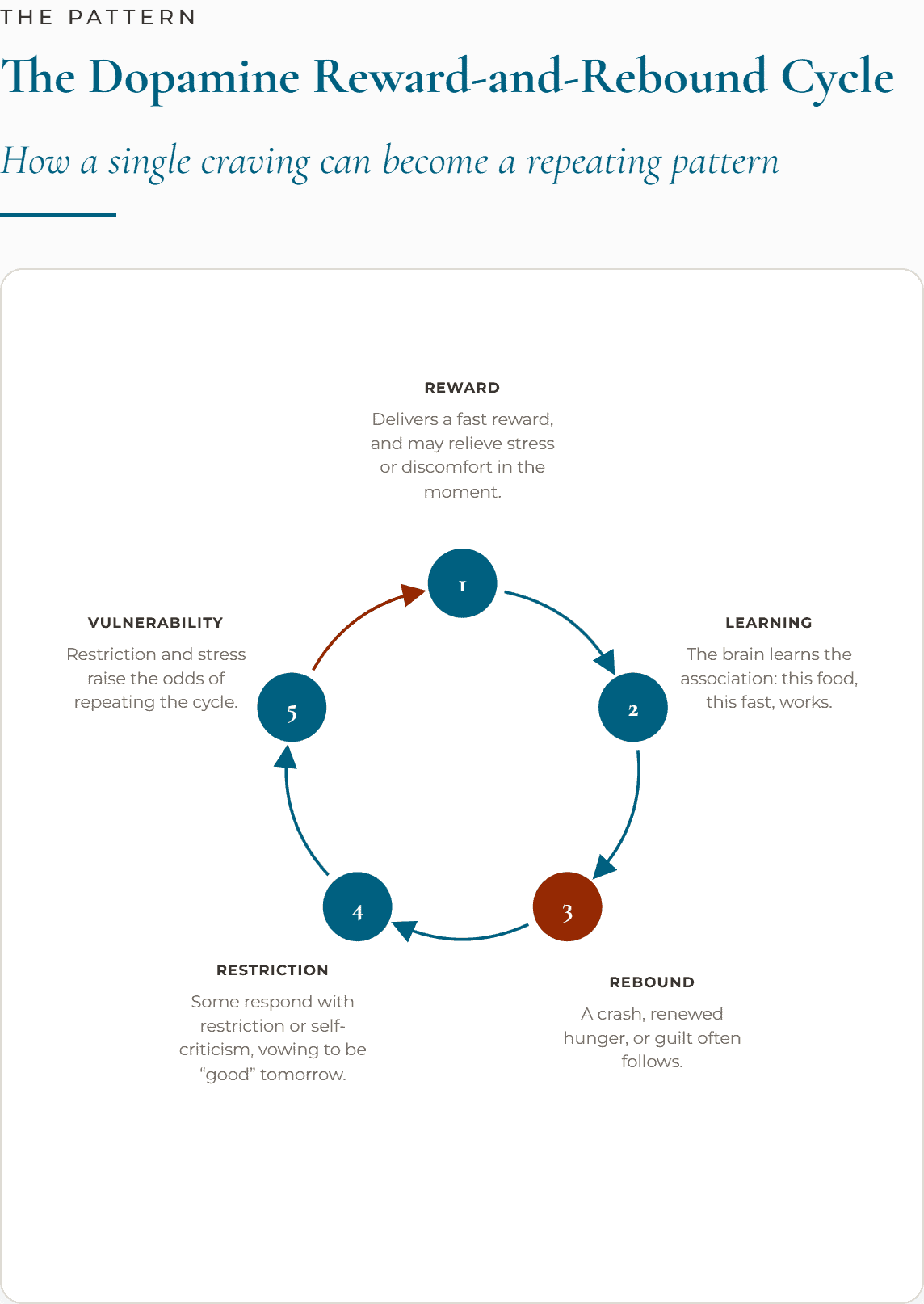
This model holds up better than "dopamine high" language because it accounts for learning, conditioned cues, stress physiology, and emotional regulation all at once, not dopamine in isolation. Review literature on loss-of-control eating describes hyperactive reward circuitry and dopamine dysregulation in response to ultra-processed food that closely resembles the pattern seen in substance-use disorders, which supports treating this as a learned, reinforced cycle rather than a single-food event.3
Stress, Emotional Eating, and the Nervous-System Connection
For many people, this cycle doesn't start with hunger, or even with the sight of food. It starts with a nervous system state, overwhelm, loneliness, exhaustion, anxiety, an emotional flashback, conflict, or the flat, disconnected feeling of being shut down. Highly palatable food offers something reliable and fast, a quick shift in sensation. It can soothe, stimulate, distract, numb, or create a sense of predictability when very little else does in that moment.
That doesn't make someone weak, and it doesn't mean every craving is trauma-driven. It means food can become a learned way of handling a nervous system state when it works quickly and nothing else is available, familiar, or enough in the moment. The behavior made sense given what someone had to work with at the time.
The goal isn't to strip comfort out of food. It's building enough other sources of regulation, connection, rest, and support that food isn't carrying that entire job by itself.
Dopamine Genes, SNPs, and Food Cravings: What We Know
Several well-studied genetic variants affect dopamine receptor density, dopamine clearance, and dopamine reuptake, and researchers have asked whether these variants explain why two people can eat the same diet and end up with very different relationships to food. The honest answer from the current research is that it's partial, inconsistent, and never separate from environment.
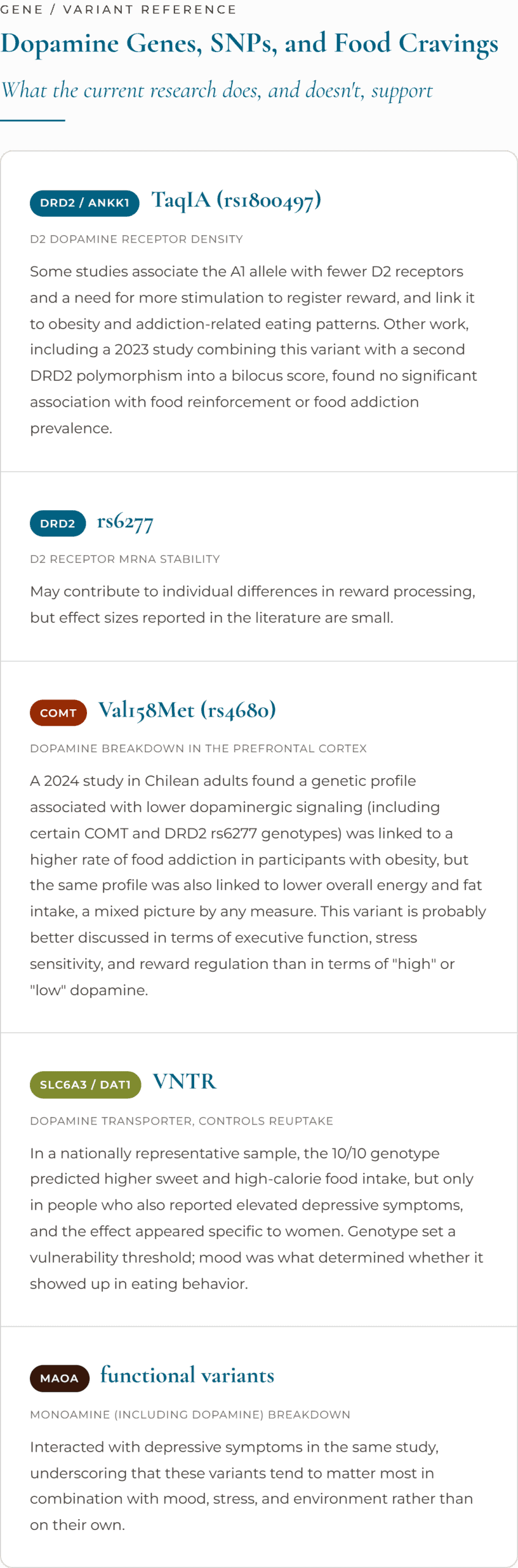
Two things are worth sitting with here. First, the field disagrees with itself. A 2023 study specifically designed to test whether a combined DRD2/ANKK1 genetic score predicted food addiction found no significant association at all (reference 5). That result belongs in the article for a reason. It shows how far the current evidence actually reaches. Second, the studies that do find associations tend to find them in interaction with something else, depressive symptoms, sex, metabolic status, or stress exposure, rather than the gene acting alone. Genotype appears to set a threshold. Whether that threshold gets crossed seems to depend heavily on mood, sleep, stress load, and the food environment a person is actually living in.
None of this supports the idea that a genetic panel can tell someone they are "predisposed to food addiction" or "genetically dopamine deficient." It can, at most, describe a statistical tendency observed in group-level research, one that a consumer genetic test cannot translate into an individual diagnosis or a specific diet recommendation.
Is Food Addiction Real? Symptoms, Science, and Limits
Food addiction is not a standalone diagnosis in the DSM-5. The research tool most commonly used to study it, the Yale Food Addiction Scale, was built to mirror the DSM's substance use disorder criteria, things like loss of control, persistent cravings, unsuccessful attempts to cut back, and continued use despite negative consequences, applied specifically to ultra-processed foods.7 It's a research and screening instrument, not a self-diagnosis tool, and researchers are still actively debating the best terminology for describing it, in part because imprecise language can undermine both clinical recognition and treatment access.8
What that research framework does capture is real. Some people experience a genuine loss of control around certain foods, distress when they try to cut back, and a pattern that closely resembles substance-use disorder in its structure, even without a formal diagnostic label.7 That experience deserves to be taken seriously. It isn't a moral failure or evidence of weak willpower. Biology, learning history, environment, and, often, food specifically engineered to be hard to stop eating are usually why it happens.
It helps to tell the difference between hunger and a cue-driven urge, since they call for different responses. These patterns can help you get curious about what's happening. They aren't a diagnostic test, and hunger and cravings commonly overlap, especially for anyone with a dieting history, gastrointestinal symptoms, or a body that's learned to distrust its own signals.
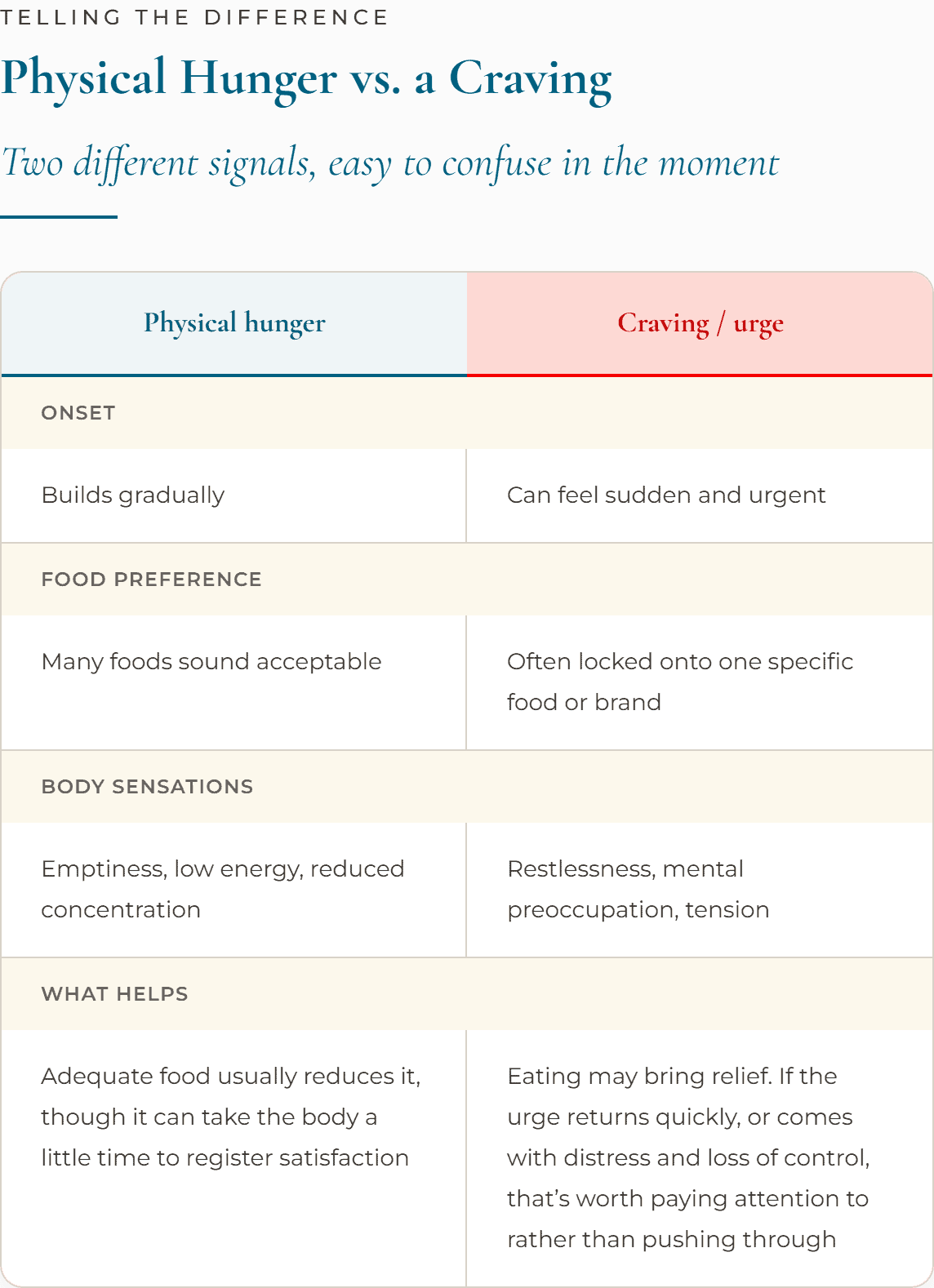
Neither state is a character flaw. Both are information. And they frequently coexist, which is exactly what makes this so hard to sort out in the moment.
How to Respond to Food Cravings Without a Dopamine Detox
I'd steer away from anything marketed as a dopamine detox or a 30-day reset. Sudden, highly restrictive rules tend to intensify preoccupation with food and increase the odds of a rebound for many people, which is the opposite of the goal.
A more sustainable starting point usually looks like building a reliable structure of meals across the day, with enough protein, fiber, and food overall that the body isn't running on empty by evening. Noticing patterns without judgment, what time it is, what mood preceded the urge, what happened afterward, tends to surface useful information faster than any food rule does.
Some people find it helpful to build a short pause into a craving before acting on it. One version of this, sometimes called a ten-minute curiosity check, starts by noticing that you can still choose to eat. Pausing isn't the same as denying yourself. From there, check in with your body. When did you last eat enough, and are you shaky, depleted, cold, or tired? Name what happened right before the urge showed up, a stressful moment, loneliness, a specific cue, fatigue, or an emotion. Meet whatever the most immediate need actually is. Eat something if you're genuinely hungry, or try one grounding action, water, a walk, music, a shower, or reaching out to someone, if you're not physically hungry. Then decide. If you still want the food afterward, eat it as a choice rather than as proof that you failed.
Widening the list of things that reliably feel good, movement, music, connection, rest, and sensory grounding, matters too, since food can only be one source of reward among several.
A fast-food meal on a hard day is not a failure. The goal is to expand choice and reduce harm, not achieve dietary purity.
Can You Have Withdrawal-Like Symptoms From Processed Foods?
Cutting back on highly processed foods can feel harder than people expect, and that's worth naming plainly. Some people notice headaches, irritability, low mood, fatigue, restlessness, or a preoccupation with food that can feel unusually intense or persistent. Researchers studying addictive-like eating have built experiences like these, things that resemble tolerance and withdrawal, into the tools they use to assess it.7 That doesn't mean cutting back on processed food is the same as withdrawing from alcohol, benzodiazepines, or opioids, and it shouldn't be treated as medically dangerous by default.
If symptoms are severe, if eating becomes increasingly restricted, or if there's bingeing, purging, fainting, dehydration, severe depression, or suicidal thinking involved, that's a reason to get professional support quickly rather than waiting it out.
When Food Cravings Need Professional Support
Persistent or intense loss of control around food, especially alongside bingeing, purging, fasting, or other compensatory behaviors, significant weight change, or co-occurring depression, anxiety, or substance use, is a reason to bring in an eating-disorder-informed therapist, a registered dietitian, or a prescribing clinician, working alongside your existing medical team. Nutrition and nervous system education can support that work. It isn't a substitute, and coordinated, collaborative care tends to produce better outcomes than any single approach working alone.
If food has become the fastest, most reliable route to comfort, numbness, stimulation, or relief you have, that pattern developed for a reason, and it's not a measure of your character. Restoring enough safety, structure, nourishment, and support so that food isn't carrying that entire load by itself is the actual work, and it's worth doing with people in your corner.
NOTE: This piece is meant for education and reflection, not for diagnosing dopamine deficiency, food addiction, or an eating disorder. If food feels out of control, or if eating involves purging, prolonged restriction, fainting, dehydration, severe depression, or thoughts of self-harm, please reach out to an eating-disorder-informed medical or mental health professional as soon as you can.
Living with cancer, autoimmunity, or complex chronic illness? Check out these success stories from clients who addressed the root-cause contributors that were disrupting their terrain, leaving them vulnerable to disease, and are now thriving!
FAQs
Dopamine is involved in motivation, learning, anticipation, and the drive to pursue a reward, not just pleasure. With food, it can make a familiar cue, a restaurant smell, a package, a time of day, a stressful moment, feel urgent and important. That's why someone can want a food intensely even when eating it isn't especially enjoyable anymore.
Highly palatable foods, ones combining refined carbohydrate, added sugar, fat, salt, and intense flavor, can activate the brain's reward system more strongly than less processed foods. "Dopamine hit" is informal shorthand, though. Food reward involves dopamine along with learning, sensory experience, hunger, fullness, stress, and emotional context, not one neurotransmitter acting alone.
Food doesn't deliver dopamine straight to the brain. Protein foods like fish, poultry, meat, eggs, beans, lentils, soy, nuts, seeds, and dairy for those who tolerate it supply tyrosine and phenylalanine, the amino acids dopamine is built from. Adequate protein and overall nutrient sufficiency support normal neurotransmitter function, but no single food reliably "boosts" dopamine on demand.
No single food has been shown to drain a fixed supply of brain dopamine in humans. The more accurate concern is that frequent reliance on highly rewarding, ultra-processed foods may be associated with changes in reward learning and reward sensitivity over time in some people. A donut doesn't use up your dopamine for the day, patterns and individual vulnerability matter more than any single food.
Many are engineered combinations of refined carbohydrate, fat, salt, and concentrated flavor that are unusually reinforcing and easy to eat quickly. Repeated eating in response to stress, fatigue, restriction, or a familiar cue can teach the brain that a specific food provides fast relief. That's a learned, reinforced pattern, not proof of weak willpower.
Food addiction is actively studied, especially around ultra-processed foods, but it isn't a standalone diagnosis in the DSM-5. Researchers commonly use the Yale Food Addiction Scale to assess experiences like cravings, loss of control, unsuccessful attempts to cut back, and continued eating despite negative consequences. Persistent distress or loss of control deserves support whether or not someone uses the term food addiction.
No. Variants in genes like DRD2/ANKK1, COMT, SLC6A3/DAT1, and MAOA may be associated with differences in reward processing or dopamine metabolism in some studies, but the findings are mixed and the effects are usually small. Mood, sleep, stress, trauma history, restrictive eating, metabolic health, and food environment tend to matter more than any one genetic variant.
There's no established clinical protocol that resets dopamine receptors or cures food cravings. For many people, strict food rules and abrupt restriction increase preoccupation and rebound eating instead. Adequate, regular nourishment, awareness of triggers, nervous system support, and eating-disorder-informed care when cravings involve real loss of control tend to hold up better over time.
Unanswered Questions?
Ask AI for Answers Based On This Post
References:
- Robinson TE, Berridge KC. The psychology and neurobiology of addiction: an incentive-sensitization view. Addiction. 2000;95(Suppl 2):S91-S117. doi:10.1046/j.1360-0443.95.8s2.19.x
- Fernstrom JD, Fernstrom MH. Tyrosine, phenylalanine, and catecholamine synthesis and function in the brain. J Nutr. 2007;137(6 Suppl 1):1539S-1547S.
- Ifland J, Brewerton TD. Binge-type eating disorders and ultra-processed food addiction: phenomenology, pathophysiology and treatment implications. Front Psychiatry. 2025;16:1584891. doi:10.3389/fpsyt.2025.1584891
- Luengo N, Goldfield GS, Obregón AM. Association between dopamine genes, adiposity, food addiction, and eating behavior in Chilean adult. Front Nutr. 2024;11:1466384. doi:10.3389/fnut.2024.1466384
- Hidalgo Vira N, Oyarce K, Valladares Vega M, Goldfield GS, Guzmán-Gutiérrez E, Obregón AM. No association of the dopamine D2 receptor genetic bilocus score (rs1800497/rs1799732) on food addiction and food reinforcement in Chilean adults. Front Behav Neurosci. 2023;17:1067384. doi:10.3389/fnbeh.2023.1067384
- Agurs-Collins T, Fuemmeler BF. Dopamine polymorphisms and depressive symptoms predict foods intake: results from a nationally representative sample. Appetite. 2011;57(2):339-348. doi:10.1016/j.appet.2011.05.318
- Meule A, Gearhardt AN. Ten years of the Yale Food Addiction Scale: a review of version 2.0. Curr Addict Rep. 2019;6(3):218-228. doi:10.1007/s40429-019-00261-3
- McCausland HC, Gearhardt AN, Peralta JM, LaFata EM. A critical evaluation of the terms used to describe foods implicated in addictive-like eating. Curr Addict Rep. 2025;12(1):71. doi:10.1007/s40429-025-00689-w


Comments
No Comments