

If you're working with a lower-carbohydrate or ketogenic approach to support steadier blood sugar, reduce the glucose rollercoaster, or work alongside your care team on the metabolic piece of a bigger health picture, you've probably had this moment: your ketones did something you didn't expect, and none of the explanations floating around the internet actually held up. One concept that may shed light on these moments is oxidative priority.
Most of what's out there on this topic, including some material I've leaned on myself in the past, describes the body's oxidative priority mechanism like a set of fuel tanks that fill and drain one at a time: burn off your blood sugar, then your glycogen, then finally your body finds its way to fat and ketones. It's a tidy metaphor. But taken literally, it misrepresents how human fuel metabolism actually works. The human body is way more complex and masterful in it's metabolic symphony.
Here's the version that's actually defensible in the research, and more useful for what you're trying to do.
QUICK REFERENCE
- Your body runs on a blend, not a sequence
- What actually determines whether you're making ketones
- The liver glycogen piece nobody explains well
- Exogenous ketones: not the shortcut they're marketed as
- Protein does not sabotage ketosis
- When this needs to be a conversation with your medical team, not a solo project
- The bottom line
- FAQs
- Unanswered Questions?
- Discussion
Your body runs on a blend, not a sequence
At any given moment, your body is oxidizing glucose, fatty acids, and, depending on conditions, ketone bodies and amino acids simultaneously, not one at a time. What changes, meal to meal and hour to hour, is the proportion each one contributes. This is the real substance behind the term "oxidative priority": some fuels get relative priority for oxidation because of how they're handled metabolically, not because your body works through a checklist.¹⁻³
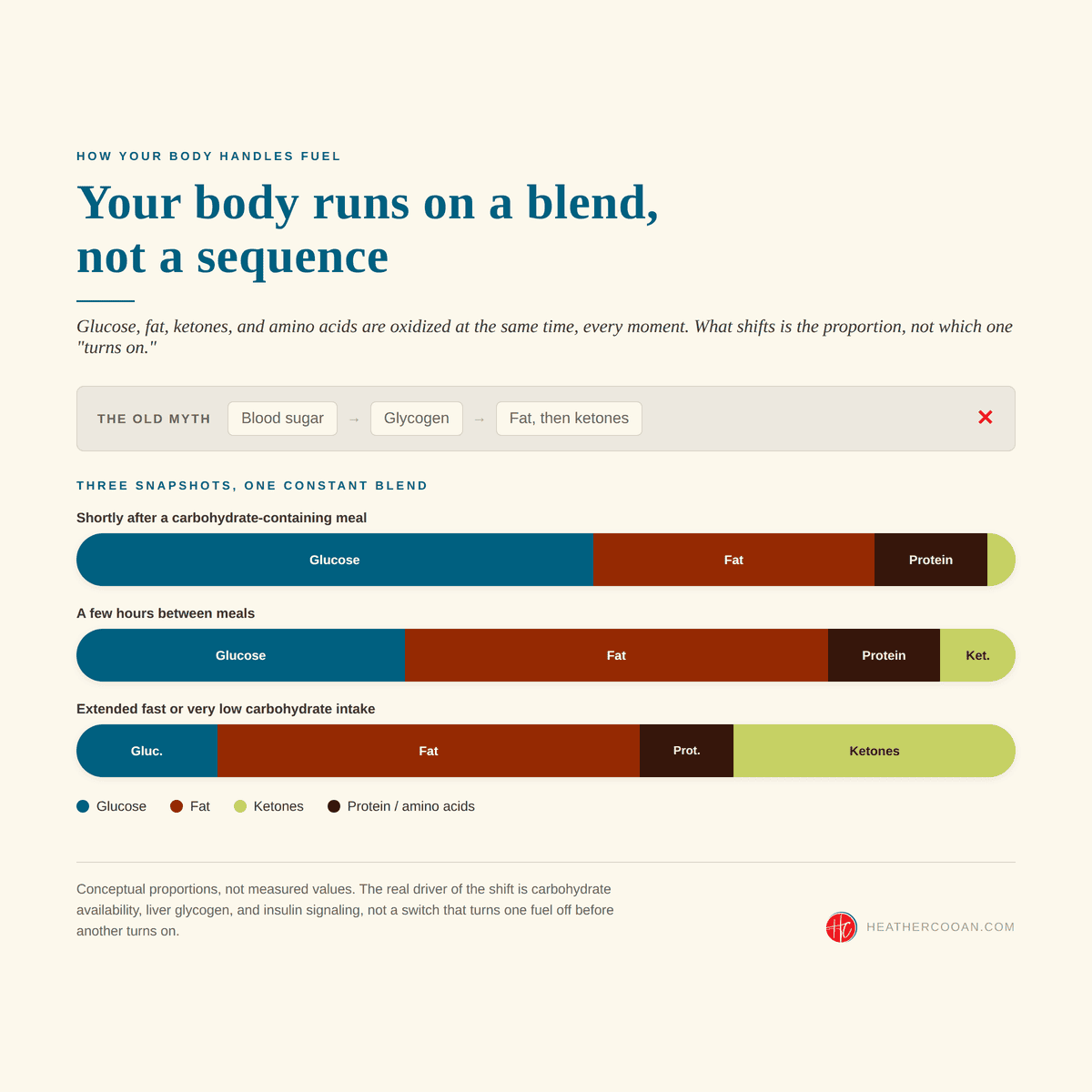
The clearest example: alcohol, which has no dedicated storage depot in the body, so it gets metabolized promptly and can temporarily suppress fat oxidation while that's happening; it may also make your glucose and ketone readings harder to interpret on days you drink.¹ Protein and carbohydrate oxidation also both rise fairly directly with intake. Dietary fat is different because adipose tissue can store nearly unlimited energy; fat oxidation doesn't ramp up as tightly in response to fat intake the way carb and protein oxidation do.¹,³ That's a real, useful distinction. It is not the same as saying your body "can't" access fat or ketones until glucose is depleted - fat oxidation is happening in the background essentially all the time, even in a normal overnight fast.¹
What actually determines whether you're making ketones
This is the part that matters for what you're doing. Nutritional ketosis is a normal metabolic state where your liver converts fatty acids into ketone bodies, mainly beta-hydroxybutyrate (BHB), when carbohydrate availability and insulin signaling are low enough, relative to your energy demand, to favor that pathway.⁴
A blood BHB concentration of approximately 0.5 mmol/L or above is commonly used to identify nutritional ketosis. Beyond that threshold, there is no universal "best" ketone number; the useful or clinically appropriate range depends on why ketosis is being used, the protocol, the medication context, symptoms, nutritional status, and what's being monitored.⁴ Some studies and clinical protocols use low-level ketosis around 0.5-1.0 mmol/L. Others, for specific supervised applications, may target higher ranges or interpret BHB alongside glucose using a glucose-ketone index; these are protocol-specific targets set by a research or clinical team for a particular purpose, not a universal goal for everyone on a ketogenic approach.⁴
This matters because a higher ketone number isn't automatically better. What determines whether the liver is actually producing more ketones from fat comes down to liver glycogen status, insulin signaling, how long it's been since you ate, and activity, not just what your meter says at a given moment. A single BHB reading is a snapshot of current metabolic conditions, not proof of deeper "fat adaptation" or better health.
The liver glycogen piece nobody explains well
If you want one mental model to replace "empty tank, then the next tank," make it this: liver glycogen is the bridge. As carbohydrate availability declines, time since your prior meal lengthens, and liver glycogen becomes less available, the metabolic environment often shifts toward lower insulin signaling and greater delivery of fatty acids to the liver. Those conditions generally favor hepatic ketone production. But the response is still individualized, and it can be altered by exercise, illness, sleep disruption, stress hormones, medications, energy intake, and your degree of keto adaptation. These factors commonly travel together, but they vary independently, which is part of why two people eating the same way can produce very different numbers.
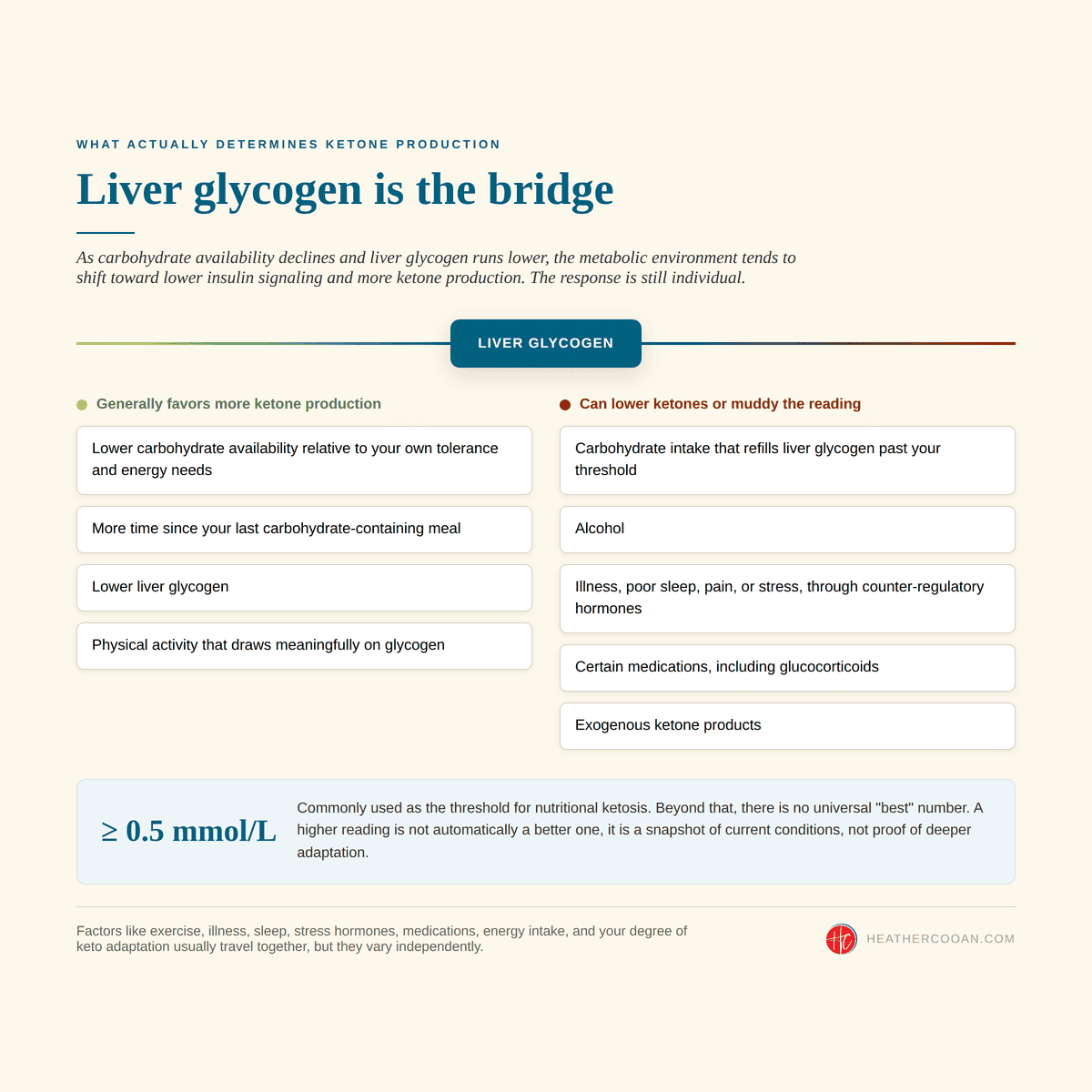
Things that generally favor more ketone production:
- Lower carbohydrate availability relative to your individual tolerance and energy needs
- More time since your last carbohydrate-containing meal
- Lower liver glycogen
- Physical activity that draws meaningfully on glycogen
Things that can lower ketones or make readings less predictable:
- Carbohydrate intake that refills liver glycogen past your threshold
- Alcohol
- Illness, poor sleep, pain, or stress (via counter-regulatory hormones)
- Certain medications, including glucocorticoids
- Exogenous ketone products worth their own callout, below
Exogenous ketones: not the shortcut they're marketed as
Store-bought ketone supplements raise your blood BHB without your liver actually producing more of it. They also work against certain goals for a mechanistic reason: beta-hydroxybutyrate can directly suppress lipolysis (fat release from adipose tissue), which lowers circulating fatty acids.⁵ Researchers studying this have noted that combining exogenous ketones with an already-ketogenic diet can be counterproductive for someone specifically trying to maximize fat mobilization.⁵ If you're using ketone supplements to "prove" you're in ketosis or to push a number higher, that reasoning doesn't hold up.
Read My Full Guide to Exogenous Ketones
Protein does not sabotage ketosis
This is the piece I most want to correct, because it matters enormously for people navigating cancer or complex chronic illness: you do not need to fear protein to stay in ketosis, and your body does not wait until all other fuel is gone before it uses amino acids to support glucose production.
Gluconeogenesis, making glucose from noncarbohydrate substrates, including amino acids, is a normal, continuously regulated process. It becomes more important when carbohydrate availability is lower, during fasting, with exercise, and whenever the body needs glucose. But dietary protein does not simply turn into glucose, calorie for calorie, on command. In a human tracer study designed to maximize this conversion, participants ate a carbohydrate-free egg-protein meal after an overnight fast and produced about 50 g of glucose over the following eight hours, but only about 4 g came directly from the dietary amino acids in that meal. Dietary amino acids accounted for roughly 8% of total endogenous glucose production; the rest came from endogenous sources.⁶
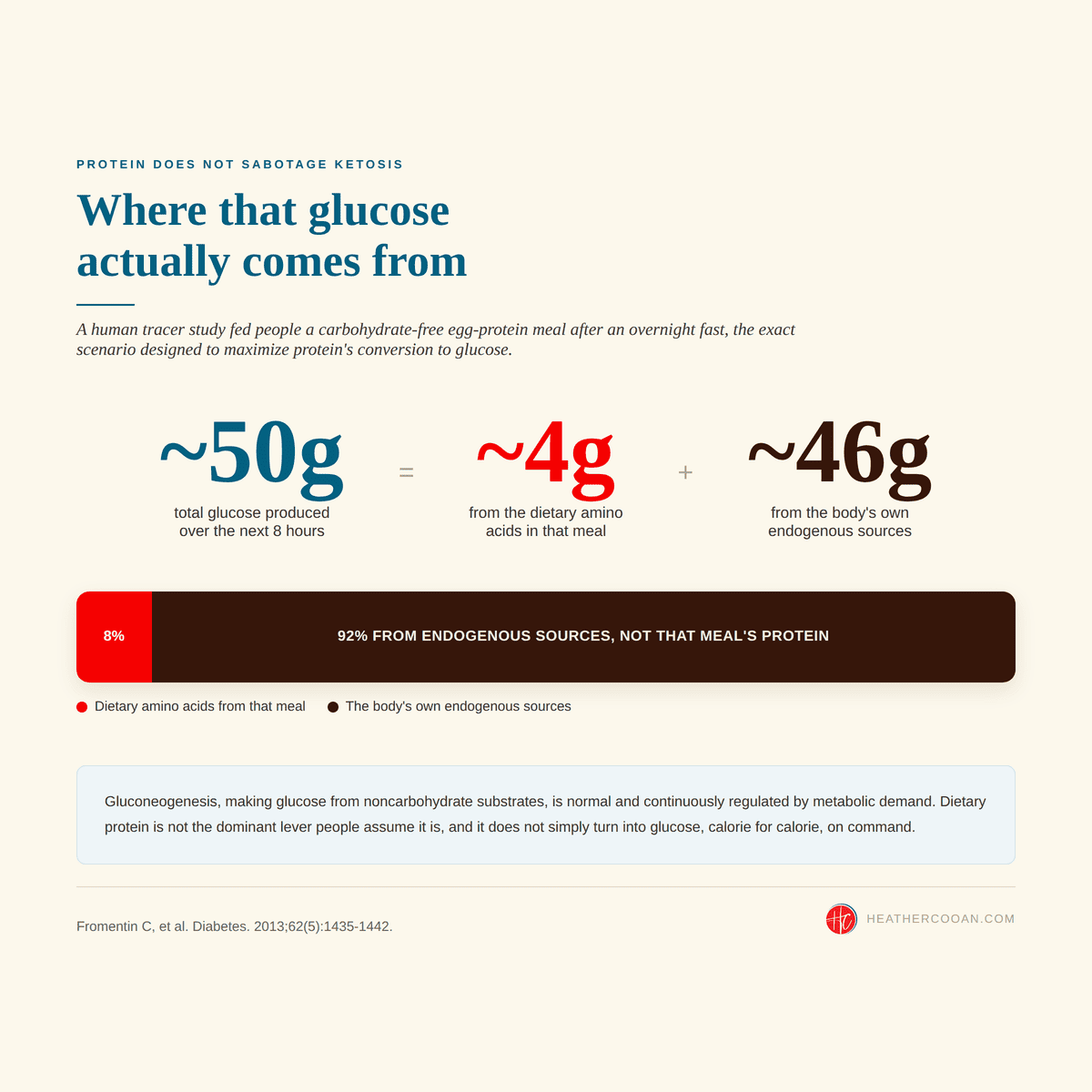
That doesn't mean protein is irrelevant to glucose metabolism; it means gluconeogenesis is regulated by metabolic demand and draws on several substrates, and dietary protein isn't the dominant lever people assume it is. Your body has no dedicated protein-storage tank comparable to glycogen or adipose tissue. Dietary protein supplies amino acids for tissue turnover and repair, immune and enzyme function, and lean-mass maintenance.
Depending on metabolic demand, amino-acid carbon can also be oxidized or contribute to gluconeogenesis that's normal physiology, not evidence that protein has "ruined" ketosis.
The goal is not to minimize protein to chase a ketone number. It's to meet an adequate, individualized protein target while using carbohydrate intake, meal timing, liver glycogen status, activity, energy intake, and your own metabolic context to shape ketone production.
When this needs to be a conversation with your medical team, not a solo project
I say this every time, and I mean it as a floor, not a formality: a ketogenic or very-low-carbohydrate approach is not a self-directed experiment for everyone. This is a conversation to have with your physician before starting or meaningfully intensifying one if:
- You use insulin, a sulfonylurea, an SGLT2 inhibitor, or medications affecting blood pressure or fluid balance
- You have type 1 diabetes
- You are pregnant or breastfeeding
- You have a history of disordered eating
- You have pancreatic, liver, kidney, or gallbladder considerations, or a known fatty-acid oxidation concern

The SGLT2 inhibitor interaction is underappreciated: case reports have documented euglycemic diabetic ketoacidosis, a serious medical emergency that can occur even when blood glucose isn't dramatically elevated in people combining an SGLT2 inhibitor with a ketogenic or very-low-carbohydrate diet, in one case after a single dose.⁷ Medication adjustments, hydration, electrolyte needs, and sick-day guidance should be planned with your prescribing team rather than improvised after your glucose readings change.
And if you're navigating cancer or another complex chronic illness, how any of this gets applied belongs in the context of your full picture: treatment status, labs, medications, appetite, and what your care team is already tracking. What I can do is help you understand the mechanism clearly enough to bring sharper questions to that conversation, and help you translate whatever direction your team supports into something sustainable day to day.
The bottom line
Ketosis isn't a metabolic magic trick, and it isn't a moral scoreboard. It's a measurable shift in fuel availability and hormone signaling, one that reflects what's happening with your liver glycogen, your insulin, and the composition and timing of what you're eating.
Understanding that mechanism, instead of a stacked-tanks metaphor that oversells the model, lets you interpret your own numbers accurately and use this tool the way it's meant to be used: alongside your care team, in service of your terrain, not as a performance to chase.
Living with cancer, autoimmunity, or complex chronic illness? Check out these success stories from clients who addressed the root-cause contributors that were disrupting their terrain, leaving them vulnerable to disease, and are now thriving!
FAQs
Oxidative priority describes how the body's fuels (alcohol, protein, carbohydrate, fat, and ketones) differ in storage capacity and how readily their oxidation shifts after you eat. It's often misunderstood as a strict burn order, but your body actually uses multiple fuels at once; what changes is the proportion each one contributes.
No. A blood BHB reading is a snapshot of current metabolic conditions such as liver glycogen, insulin signaling, and time since eating. Research shows nutritional ketosis begins around 0.5 mmol/L, but higher isn't automatically better; the useful range depends on why you're using ketosis and should be set with your care team.
Not in the way most people think. Exogenous ketones raise blood BHB directly without requiring your liver to produce more, and research shows they can actually suppress fat release from fat cells (lipolysis). They don't reliably increase fat-burning and aren't a substitute for the dietary and metabolic conditions that drive real ketone production.
Not to the degree many people fear. Even in a study designed to maximize protein's conversion to glucose, dietary amino acids accounted for only about 8% of total glucose production. Protein doesn't convert to glucose on command; it primarily supports tissue repair, immune function, and lean mass, which matters even more during illness.
Unanswered Questions?
Ask AI for Answers Based On This Post
References:
- Cronise RJ, Sinclair DA, Bremer AA. Oxidative priority, meal frequency, and the energy economy of food and activity: implications for longevity, obesity, and cardiometabolic disease. Metab Syndr Relat Disord. 2017;15(1):6-17. doi:10.1089/met.2016.0108
- Flatt JP. Carbohydrate balance and body-weight regulation. Proc Nutr Soc. 1996;55(1B):449-465. doi:10.1079/pns19960041
- Flatt JP. Macronutrient composition and food selection. Obes Res. 2001;9(suppl 4):256S-262S. doi:10.1038/oby.2001.128
- Fante C, Spritzler F, Calabrese L, Laurent N, Roberts C, Deloudi S. The role of β-hydroxybutyrate testing in ketogenic metabolic therapies. Front Nutr. 2025;12:1629921. doi:10.3389/fnut.2025.1629921
- Falkenhain K, Islam H, Little JP. Exogenous ketone supplementation: an emerging tool for physiologists with potential as a metabolic therapy. Exp Physiol. 2023;108(2):177-187. doi:10.1113/EP090430
- Fromentin C, Tomé D, Nau F, et al. Dietary proteins contribute little to glucose production, even under optimal gluconeogenic conditions in healthy humans. Diabetes. 2013;62(5):1435-1442. doi:10.2337/db12-1208
- Mistry S, Cocks Eschler D. Euglycemic diabetic ketoacidosis caused by SGLT2 inhibitors and a ketogenic diet: a case series and review of literature. AACE Clin Case Rep. 2021;7(1):17-19. doi:10.1016/j.aace.2020.11.009




Comments
No Comments