

The strategy that kept you safe as a child may still be running your health.
QUICK REFERENCE
- THREE CORNERS, ONE JOB
- WHAT THE RESEARCH ON CHILDHOOD ADVERSITY SHOWS
- WHAT THE RESEARCH DOES NOT SHOW
- WHERE THE PATTERN MEETS THE BODY
- THE EIGHTEEN PATTERNS, AND HOW THEY FOLLOW YOU INTO YOUR CARE
- LIVING WELL WITH A DIAGNOSIS IS AN ARCHITECTURE PROBLEM
- WHERE TO START
- FAQs
- Unanswered Questions?
- REFERENCES
- Discussion
Long before anyone hands you a diagnosis, you have already built a system for staying alive. You built it as a kid, mostly without words, out of whatever worked in the house you grew up in. Maybe you learned to read the room before you walked into it. Maybe you learned that being useful kept you included, or that a perfect report card bought you a quiet evening.
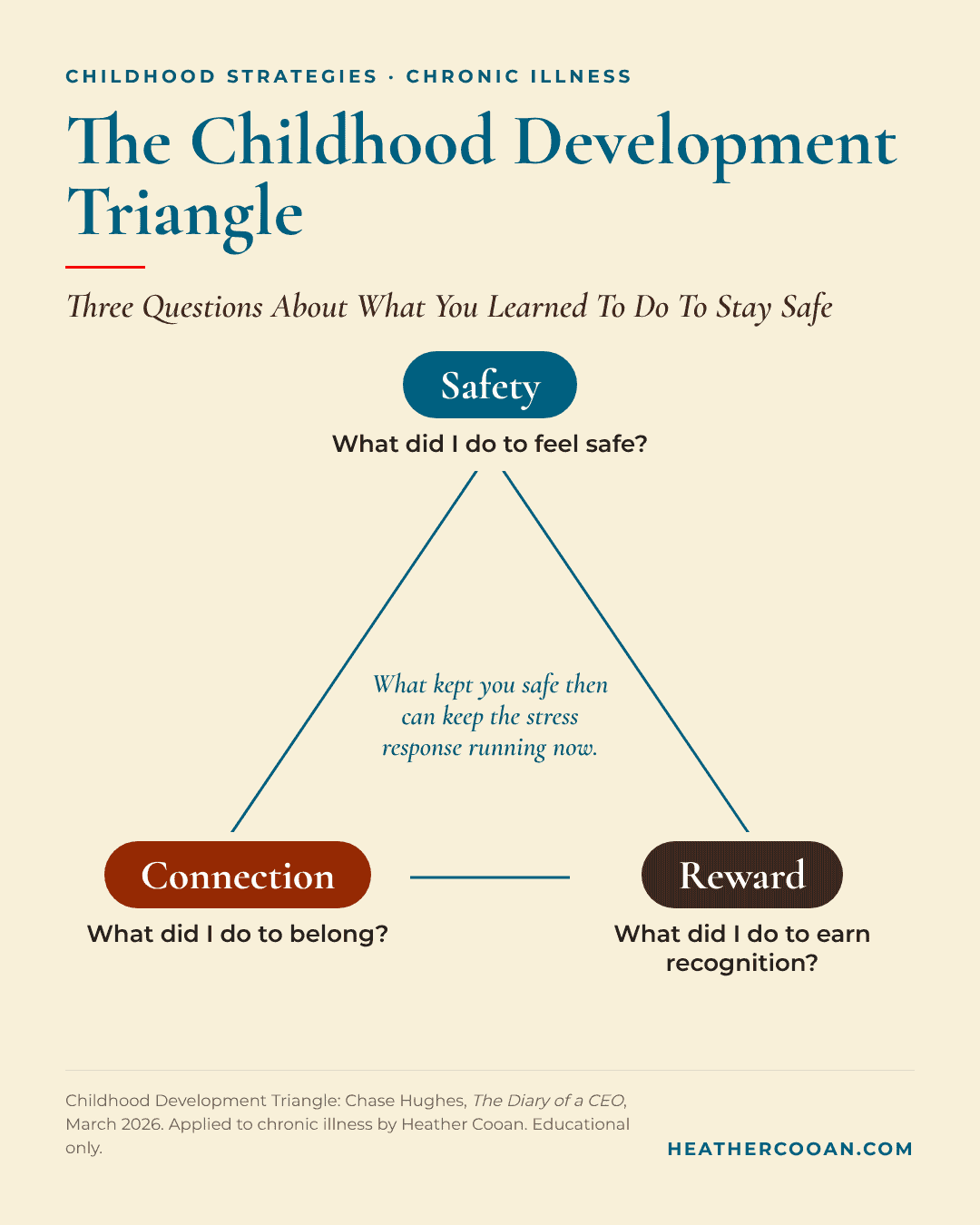
Behavior analyst Chase Hughes calls the map the Childhood Development Triangle. He introduced it in a March 2026 interview with Steven Bartlett on The Diary of a CEO. (1) The triangle asks three questions about your childhood. What did you do to feel safe? What did you do to earn connection? What did you do to earn recognition or reward?
Simirity founder Andrew Ronald took Hughes's three questions further. He described six common patterns under each corner-eighteen in all-as a guide for parents trying to understand their kids. (2) His work is written for families. What follows applies it to adults living with cancer, autoimmunity, and complex chronic illness. That application is mine, not Hughes's or Ronald's.
Neither the triangle nor the eighteen patterns has been peer-reviewed, a point Ronald makes plainly. (2) I find them useful anyway, because they give plain language to something researchers have been documenting for nearly thirty years, and because I recognize them from the inside.
I've seen them show up in my own story. As a child, I sourced safety in humor and being useful to others, and that has followed me into adulthood and manifested as workaholism: losing my identity completely in my work, building an unmanageable allostatic load, which eventually broke down my physical body and led to autoimmunity and cancer. I see it in my clients every day. These patterns are in all of us.
THREE CORNERS, ONE JOB
The answers to Hughes's three questions are adaptations. Each strategy solved a real problem with the tools a small person had. The trouble comes later, when the strategy keeps running after the danger has passed.
In my work, those long-running strategies tend to look like perfectionism, people-pleasing, over-functioning, hyperindependence, and hypervigilance. I call the work of understanding them Capacity Dynamics™, because each one draws down the same account: your adaptive capacity, the body's ability to respond to challenge and recover from it.
WHAT THE RESEARCH ON CHILDHOOD ADVERSITY SHOWS
The strongest data connecting childhood experience to adult disease come from the Adverse Childhood Experiences (ACE) research. The original Kaiser Permanente and CDC study surveyed more than 9,500 adults about childhood abuse and household dysfunction. It found a graded relationship: the more categories of adversity someone reported, the more likely they were to have heart disease, cancer, chronic lung disease, and liver disease as adults. (3)
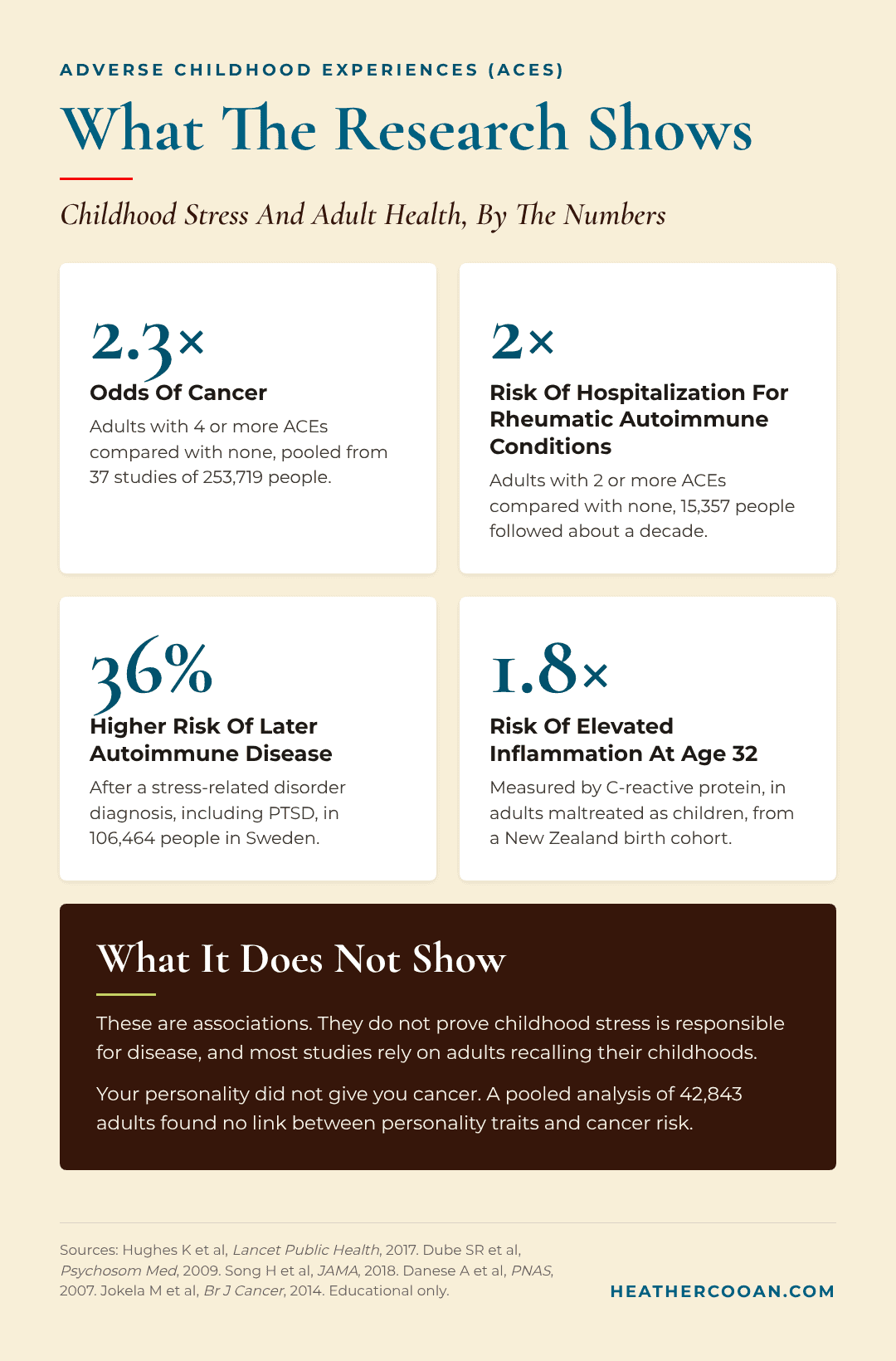
A 2017 meta-analysis pooled 37 studies covering more than 250,000 people. Those reporting four or more ACEs had about 2.3 times the odds of cancer compared with people reporting none, about twice the odds of cardiovascular disease, and about three times the odds of respiratory disease. (4)
The autoimmune data point in the same direction. A follow-up analysis of more than 15,000 ACE study participants tracked hospitalizations for 21 autoimmune conditions. Compared with people who reported no ACEs, people with two or more had a 70% higher risk in one disease group and an 80% higher risk in another, the group that includes Hashimoto's thyroiditis, rheumatoid arthritis, and lupus. For rheumatic conditions specifically, the risk doubled. (5) A separate Swedish cohort of more than 100,000 people diagnosed with stress-related disorders, including PTSD, found a 36% higher risk of later autoimmune disease than in matched controls. (6)
One of the clearest biological threads comes from the Dunedin study in New Zealand, which has followed about 1,000 people since birth. Those maltreated as children were significantly more likely to have clinically elevated C-reactive protein, a marker of inflammation, at age 32. The association held after the researchers accounted for stress in adulthood and adult health behaviors, and they estimated that more than 10% of low-grade inflammation in that population may be attributable to childhood maltreatment. (7)
WHAT THE RESEARCH DOES NOT SHOW
These are associations. The authors of the 2017 meta-analysis state directly that their study could only measure associations, and every study they included relied on adults recalling their own childhoods. (4) The Swedish autoimmune study found a real but modest absolute difference, roughly 9 versus 6 new cases per 1,000 person-years. (6) Part of the pathway also likely runs through health behaviors such as smoking and heavy drinking, which are themselves strategies a distressed nervous system reaches for. (4)
And there is a line this article will not cross. Your personality did not give you cancer. A pooled analysis of more than 42,000 adults across six long-term cohorts found no association between any of the Big Five personality traits and cancer incidence or cancer mortality. (8) The patterns in the triangle are stress strategies, and the evidence points toward chronic stress physiology and its downstream effects. It does not point toward who you are as a person.
WHERE THE PATTERN MEETS THE BODY
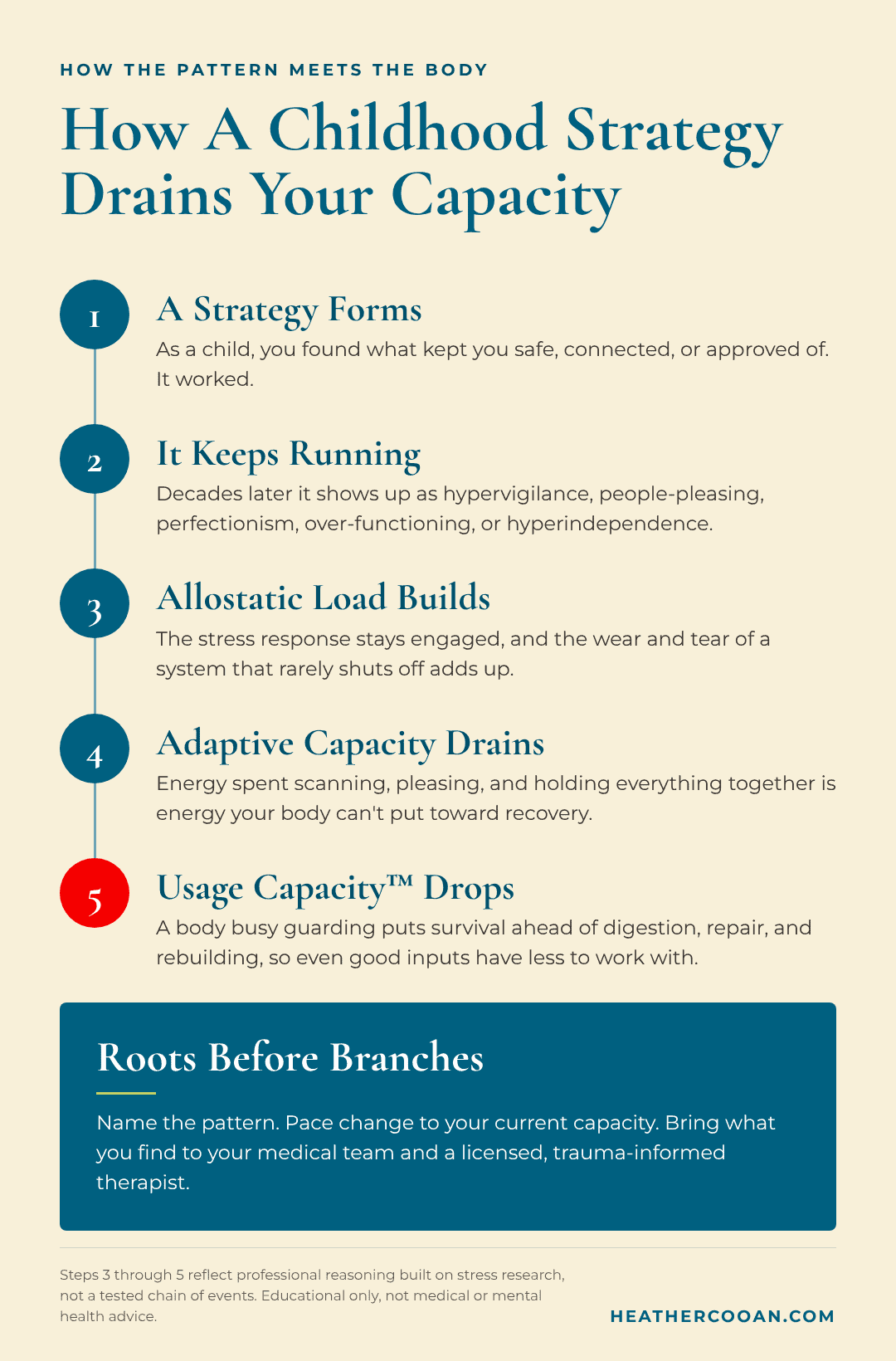
Allostasis is how the body stays stable through change. Stress hormones rise to meet a challenge and fall once it passes. Allostatic load is the wear and tear that builds when that system switches on too often, stays on too long, or never fully shuts off. (9) Andrea Danese and Bruce McEwen describe early adversity as calibrating these systems while they are still developing, with lasting changes in the nervous, endocrine, and immune systems that remain visible in adulthood. (10) At the cellular level, Robert Naviaux's cell danger response model describes cells shifting into a defended metabolic state under threat, and proposes that when this response fails to resolve, it contributes to chronic illness. (11)
Look at the triangle through that lens. Hypervigilance is threat detection that never clocks out. People-pleasing requires constant monitoring of other people's moods and steady suppression of your own needs. Perfectionism and over-functioning keep the stress response engaged long after the task should have ended. Hyperindependence means carrying every load alone, including the ones meant to be shared.
Each of these runs on the same stress physiology the ACE research keeps pointing to. The next step is my professional reasoning rather than a tested finding: a pattern that keeps the alarm on for forty years is a plausible, ongoing source of allostatic load, and one of the few sources you can actually work with.
THE EIGHTEEN PATTERNS, AND HOW THEY FOLLOW YOU INTO YOUR CARE
The strategy you built as a child follows you into the exam room. It shapes how you research, how you talk to your oncologist, how you read a lab result, and how you handle a setback.
The pattern names below are Andrew Ronald's. (2) The one-line childhood descriptions are my paraphrase of his. The adult and diagnosis examples are my own, drawn from what I see in practice.
Safety: What Did You Do to Feel Safe?
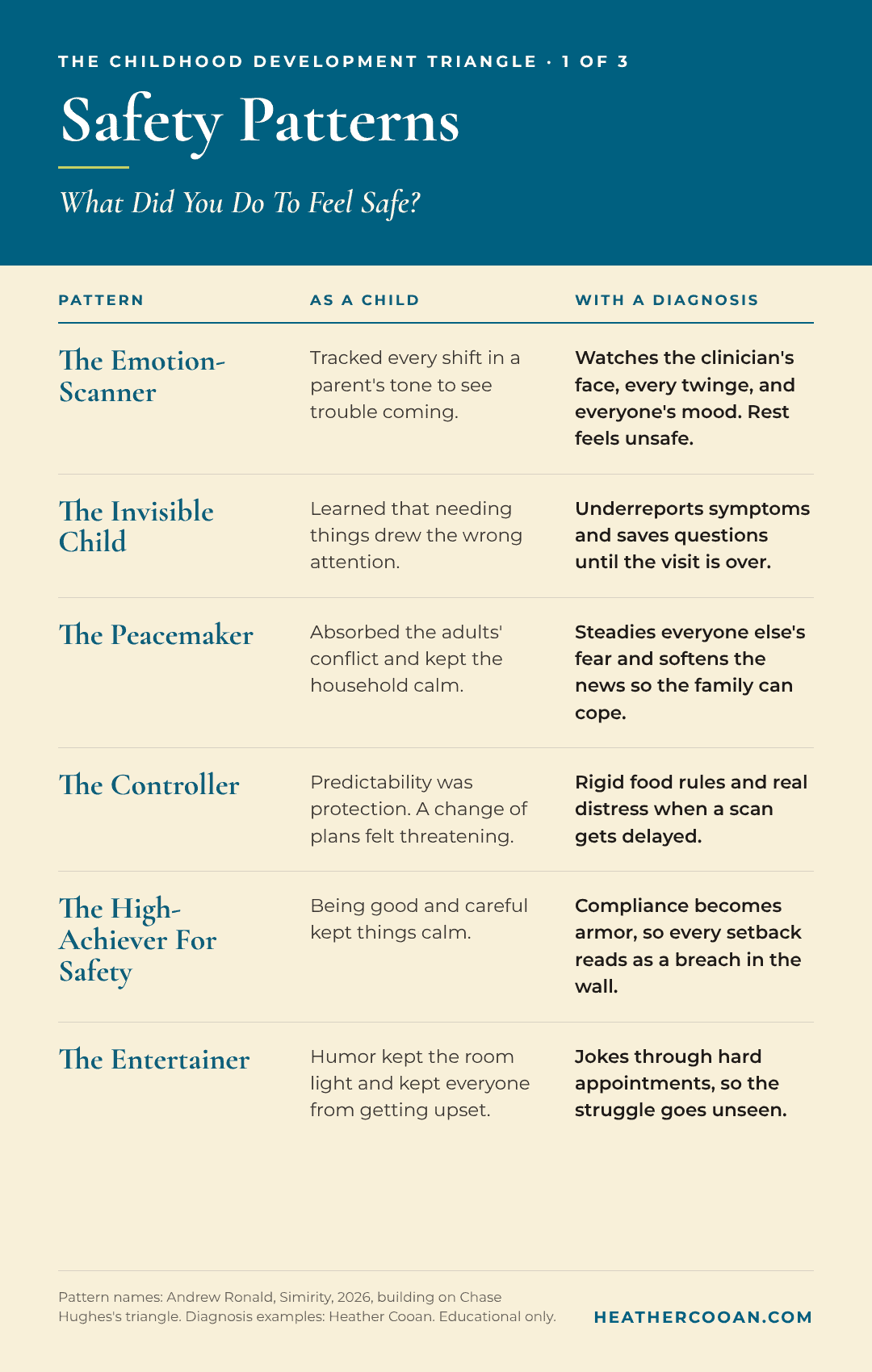
The Emotion-Scanner. This child tracked every shift in a parent's tone to see trouble coming. With a diagnosis, the scanning turns toward your oncologist's face while results load, toward every twinge in your body, and toward the mood of everyone at home. Rest is hard, because rest means looking away.
The Invisible Child. This child learned that needing things drew the wrong kind of attention. In care, you underreport symptoms, save your questions until the appointment is over, and describe crushing fatigue as "a little tired." Your team can only respond to what you let them see.
The Peacemaker. This child absorbed the adults' conflict and kept the household calm. After diagnosis, you spend your energy steadying everyone else's fear, softening the news so your family can cope, and sometimes choose the option that keeps the peace over the one that fits you.
The Controller. Predictability was this child's protection, and a change of plans felt genuinely threatening. In illness, that becomes rigid food rules, a supplement schedule run like a military operation, and real distress when a scan gets delayed. The rigidity can crowd out the flexibility a changing body needs.
The High-Achiever for Safety. This child was good, careful, and accomplished, because being good kept things calm. With a diagnosis, compliance becomes armor. Doing everything right feels like the only defense, so any symptom or setback reads as a breach in the wall.
The Entertainer. Humor kept the room light and kept everyone from getting upset. In care, you crack jokes through hard appointments, and the people around you (sometimes including your clinicians) miss how much you're struggling.
I've seen each of these patterns in my clients. The one that is particularly interesting to me is the entertainer. I had a client with breast cancer who could not make it through reviewing her labs without cracking jokes. It was how she sought safety for herself, but it also kept her from feeling and processing her emotions. She now believes this to have been part of the core of her disease process.
Connection: What Did You Do to Earn Belonging?
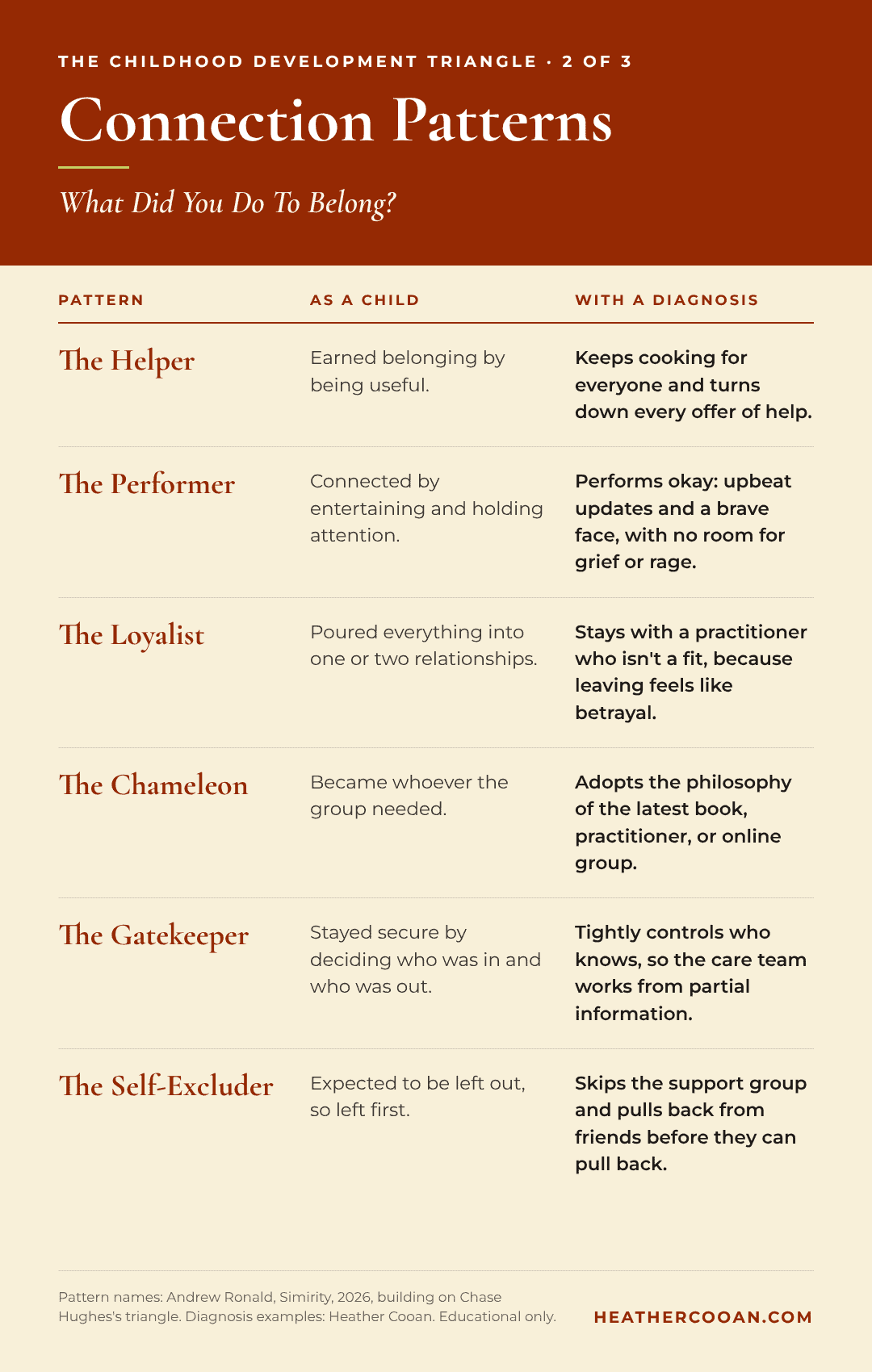
The Helper. Belonging came from being useful. During treatment, you keep cooking for everyone, keep showing up for work, and deflect every offer of help, because receiving feels like taking.
The Performer. Connection came through entertaining and holding attention. With illness, this can turn into performing okay: upbeat updates, warrior posts, and a brave face that leaves no room for grief or rage.
The Loyalist. This child poured everything into one or two relationships, and conflict inside them felt like the whole world tilting. In care, you may stay with a practitioner who isn't a fit because leaving feels like betrayal, or treat any disagreement with your team as a threat to the relationship itself.
The Chameleon. Belonging came from becoming whoever the group needed. With a diagnosis, you adopt the philosophy of whichever practitioner, book, or online group you spent the most time with lately, cycling through dietary camps and losing track of what your own body is telling you.
The Gatekeeper. Security came from controlling who was in and who was out. In illness, this can look like tight control over who knows about the diagnosis and what each person is told, sometimes leaving members of your care team working with partial information.
The Self-Excluder. This child expected to be left out, so she left first. After diagnosis, you skip the support group, pull back from friends before they can pull back from you, and call it preferring to be alone.
The gatekeeper is particularly interesting. I had a case involving breast cancer where this manifested in a practitioner-hopping capacity. The client would jump from practitioner to practitioner and provide only so much information to each practitioner to control the conversation and her interactions with that practitioner. I believe it was to control her ability to connect with the practitioner rather than to improve her health or gain expert opinion.
Reward: What Did You Do to Earn Recognition?
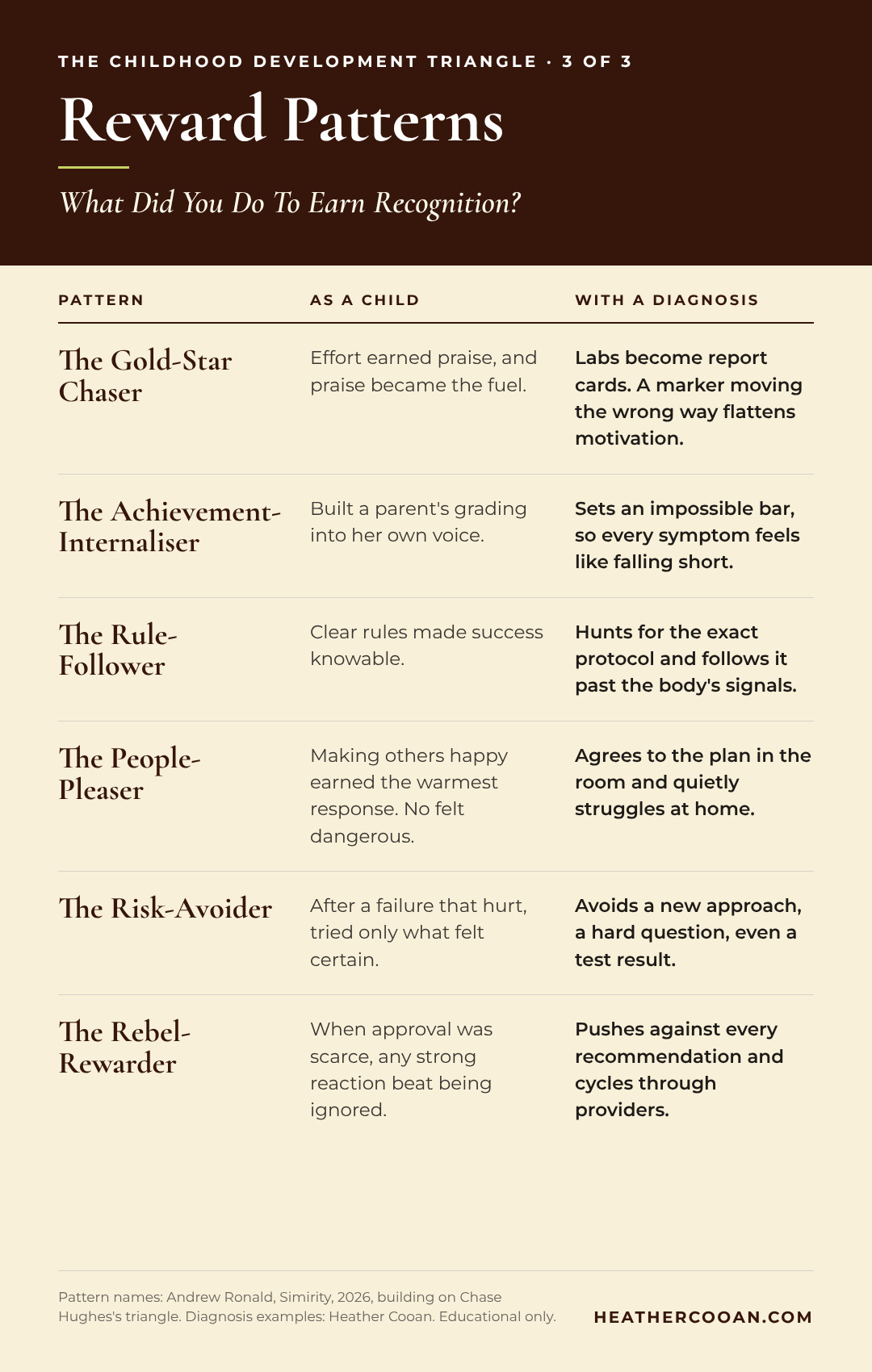
The Gold-Star Chaser. Effort earned praise, and praise became the fuel. Labs turn into report cards, and appointments become a search for a "great job." When a marker moves the wrong way, motivation can collapse.
The Achievement-Internaliser. This child absorbed a parent's pride in results and built the grading into her own head. No one has to set the bar for you, because you set an impossible one yourself, and every symptom becomes evidence you're falling short.
The Rule-Follower. Clear rules make success knowable. Individualized care is full of "it depends," which can feel unbearable, so you look for the exact protocol and follow it past the point where your body signals something needs to change.
The People-Pleaser. Making others happy earned the warmest response, and "no" felt dangerous. In care, you agree to the plan in the room and quietly struggle at home, say yes to every visitor while exhausted, and hide what isn't working so no one is disappointed.
The Risk-Avoider. A failure that hurt taught this child to try only what she was sure she could do well. With a diagnosis, that can mean avoiding a new approach, a hard question, or even a test result, because not knowing feels safer than possibly failing.
The Rebel-Rewarder. When approval was scarce or unpredictable, any strong reaction beat being ignored. In care, this can look like pushing against every recommendation, cycling through providers, or creating friction that gets a response, while the deeper need to be seen goes unmet.
The rule follower can be particularly damaging when trying to make changes to your terrain through diet and lifestyle. This can manifest in long checklists and multi-hour evening and morning routines that become overburdensome and actually add allostatic load. I see this regularly with my clients.
Most people recognize themselves in more than one corner, and often in several patterns at once. None of them makes you wrong. Each one shows you where your capacity is going.
LIVING WELL WITH A DIAGNOSIS IS AN ARCHITECTURE PROBLEM
Much of wellness culture describes a diagnosis as the start of a journey back to health. With cancer, autoimmunity, and complex chronic illness, I find architecture a more honest frame: deliberately designing your inputs so you stay as well as possible while living with the diagnosis, working collaboratively with a medical team that leads the medical decisions.
That is what Deep Nourishment™ is built for. The body is terrain, and every input either builds it or depletes it. Quality Inputs™ covers food, water, sleep, and movement, as well as your relationships, the information you take in, and the way you talk to yourself. A survival strategy is an input, too. It runs every single day, and it shapes the quality of nearly every other input you choose.
Then there is Usage Capacity™, which asks whether your body is in a state to use what you give it. A nervous system stuck in defense prioritizes survival over digestion, repair, and rebuilding. You can build a beautiful plate and still be running a pattern that keeps your body too busy guarding to make full use of it. This is why I work roots before branches. The most carefully designed nutrition sits on top of whatever your nervous system is doing underneath it.
WHERE TO START
Start by finding your patterns. Answer Hughes's three questions honestly, read through the eighteen, then add a question of your own: where is this strategy showing up in how I'm handling my diagnosis right now?
If you want to look at your own ACE history, the questionnaire is publicly available. The score is only a count of categories. It does not capture what happened to you, and it cannot predict what will happen next. Answering it can stir things up, so consider doing it with a licensed, trauma-informed therapist or a trusted person close by.
Then bring what you find into your care. Tell your medical team what you are actually doing, including the parts you have been afraid to say. Work on the pattern itself with a licensed mental health professional who understands trauma. Pace it all to your current capacity. Rewriting a forty-year strategy is slow work, and slow is allowed.
The body did not fail you. It adapted to keep you alive. Naming the pattern gives you back the choice of whether to keep running it.
This article is for educational purposes only and is not medical or mental health advice. Heather Cooan is a non-licensed nutrition consultant and does not diagnose or provide medical care. Please talk with your physician and a licensed mental health professional before making changes to your care.
Living with cancer, autoimmunity, or complex chronic illness? Check out these success stories from clients who addressed the root-cause contributors that were disrupting their terrain, leaving them vulnerable to disease, and are now thriving!
FAQs
The Childhood Development Triangle is a framework from behavior analyst Chase Hughes. It maps the strategies a child builds around three questions: What did I do to feel safe? What did I do to belong? What did I do to earn recognition? Hughes argues those strategies don't disappear in adulthood. They keep shaping how we act in relationships, at work, and, in my experience, in how we approach our health.¹
Chase Hughes introduced the triangle in a March 2026 interview with Steven Bartlett on The Diary of a CEO.¹ Simirity founder Andrew Ronald later described six common patterns under each corner, eighteen in all, as a guide for parents.² Neither the triangle nor the patterns have been peer-reviewed. They line up with established research on attachment, belonging, and reward, which is part of why they're useful.
Andrew Ronald groups them by corner. Safety: the Emotion-Scanner, the Invisible Child, the Peacemaker, the Controller, the High-Achiever for Safety, and the Entertainer. Connection: the Helper, the Performer, the Loyalist, the Chameleon, the Gatekeeper, and the Self-Excluder. Reward: the Gold-Star Chaser, the Achievement-Internaliser, the Rule-Follower, the People-Pleaser, the Risk-Avoider, and the Rebel-Rewarder.² Most people recognize themselves in several.
Research shows an association. In a study of more than 15,000 adults, people who reported two or more adverse childhood experiences had a 70% to 100% higher risk of hospitalization for several groups of autoimmune conditions than people who reported none.⁵ A Swedish study of more than 100,000 people found a 36% higher risk of later autoimmune disease after a stress-related diagnosis such as PTSD.⁶ These findings show a link, not proof that one leads to the other.
A 2017 meta-analysis found that adults reporting four or more adverse childhood experiences had about 2.3 times the odds of cancer compared with adults reporting none.⁴ Part of that link likely runs through habits like smoking and heavy drinking. The National Cancer Institute considers the evidence on stress and cancer risk mixed, and notes that any connection may be indirect.¹²
No. A pooled analysis of more than 42,000 adults across six long-term studies found no association between personality traits and cancer risk or cancer mortality.⁸ The patterns in the triangle are stress strategies, not personality flaws. Naming one is about understanding where your capacity goes, never about blame.
An ACE score counts how many of ten categories of childhood adversity, such as abuse, neglect, or household dysfunction, you experienced. It was built for population research. Its creators caution that it can't diagnose anything or predict what will happen to one person, and it doesn't capture how severe or long-lasting an experience was.¹³ Answering it can stir up difficult memories, so consider doing it with a licensed, trauma-informed therapist or a trusted person nearby.
Allostatic load is the cumulative wear and tear on your body when the stress response switches on too often, stays on too long, or never fully shuts off.⁹ Researchers describe early adversity as shaping the nervous, endocrine, and immune systems while they're still developing, with effects that remain visible in adulthood.¹⁰ A survival pattern that keeps the alarm running is one ongoing source of that load.
They show up in the exam room. An Emotion-Scanner may watch the clinician's face more than the plan. A People-Pleaser may agree to everything in the appointment and quietly struggle at home. A Gold-Star Chaser may treat lab results like report cards. Each pattern also drains adaptive capacity (the energy your body has for recovery) and lowers Usage Capacity™, your body's ability to use the good inputs you give it.
Yes. In a study of more than 6,000 adults, people who reported six or seven positive childhood experiences, such as feeling supported by family and a sense of belonging, had 72% lower odds of depression or poor mental health than those who reported zero to two. The link held even among adults with multiple adverse childhood experiences.¹⁴ Your history includes what went right, too.
Yes, though it's slow work. The pattern made sense once, and your nervous system has practiced it for decades. Start by naming it, notice where it shows up in your care, and work on it with a licensed mental health professional who understands trauma. Pace changes to your current capacity, and bring what you learn to your medical team.
Unanswered Questions?
Ask AI for Answers Based On This Post
REFERENCES
- Bartlett S, host. Manipulation expert: how to influence anyone and make them do exactly what you want! Interview with Chase Hughes. The Diary of a CEO. March 19, 2026. Accessed October 7, 2026. https://open.spotify.com/episode/7LAWGvR7MNzog1rSS8yfHJ
- Ronald A. Childhood development triangle: understanding your child. Simirity. Published March 20, 2026. Updated June 5, 2026. Accessed October 7, 2026. https://simirity.com/childhood-development-triangle/
- Felitti VJ, Anda RF, Nordenberg D, et al. Relationship of childhood abuse and household dysfunction to many of the leading causes of death in adults: the Adverse Childhood Experiences (ACE) Study. Am J Prev Med. 1998;14(4):245-258. doi:10.1016/S0749-3797(98)00017-8
- Hughes K, Bellis MA, Hardcastle KA, et al. The effect of multiple adverse childhood experiences on health: a systematic review and meta-analysis. Lancet Public Health. 2017;2(8):e356-e366. doi:10.1016/S2468-2667(17)30118-4
- Dube SR, Fairweather D, Pearson WS, Felitti VJ, Anda RF, Croft JB. Cumulative childhood stress and autoimmune diseases in adults. Psychosom Med. 2009;71(2):243-250. doi:10.1097/PSY.0b013e3181907888
- Song H, Fang F, Tomasson G, et al. Association of stress-related disorders with subsequent autoimmune disease. JAMA. 2018;319(23):2388-2400. doi:10.1001/jama.2018.7028
- Danese A, Pariante CM, Caspi A, Taylor A, Poulton R. Childhood maltreatment predicts adult inflammation in a life-course study. Proc Natl Acad Sci U S A. 2007;104(4):1319-1324. doi:10.1073/pnas.0610362104
- Jokela M, Batty GD, Hintsa T, Elovainio M, Hakulinen C, Kivimäki M. Is personality associated with cancer incidence and mortality? An individual-participant meta-analysis of 2156 incident cancer cases among 42 843 men and women. Br J Cancer. 2014;110(7):1820-1824. doi:10.1038/bjc.2014.58
- McEwen BS. Stress, adaptation, and disease: allostasis and allostatic load. Ann N Y Acad Sci. 1998;840(1):33-44. doi:10.1111/j.1749-6632.1998.tb09546.x
- Danese A, McEwen BS. Adverse childhood experiences, allostasis, allostatic load, and age-related disease. Physiol Behav. 2012;106(1):29-39. doi:10.1016/j.physbeh.2011.08.019
- Naviaux RK. Metabolic features of the cell danger response. Mitochondrion. 2014;16:7-17. doi:10.1016/j.mito.2013.08.006
- National Cancer Institute. Psychological stress and cancer. Reviewed October 21, 2022. Accessed November 15, 2026. https://www.cancer.gov/about-cancer/coping/feelings/stress-fact-sheet
- Anda RF, Porter LE, Brown DW. Inside the adverse childhood experience score: strengths, limitations, and misapplications. Am J Prev Med. 2020;59(2):293-295. doi:10.1016/j.amepre.2020.01.009
- Bethell C, Jones J, Gombojav N, Linkenbach J, Sege R. Positive childhood experiences and adult mental and relational health in a statewide sample: associations across adverse childhood experiences levels. JAMA Pediatr. 2019;173(11):e193007. doi:10.1001/jamapediatrics.2019.3007


Comments
No Comments