

Everybody knows about hot flashes. Sweaty sheets, a fan on the nightstand, and periods doing whatever the hell they want. That's the version that makes it into sitcoms and pharmacy pamphlets.
The real list is a lot longer. It includes burning tongues, electric zaps under the skin, ears that ring in a quiet room, allergies you never had before, and joints that ache as if they belong to someone twenty years older.
When women don't know the full list, two things go wrong: they pull in opposite directions and create confusion.
Most of us know the first one by heart. You walk into an appointment describing real changes in your body and walk out with "it's stress," "it's your age," "you're fat", or a referral for your anxiety. You leave with no framework and no language, just the quiet suggestion that you're making it up.
The second gets far less airtime. Once you learn how many different symptoms women describe during this transition, it gets tempting to file every new change under "probably hormones." Some of those symptoms belong to something else entirely, and a few of them need a clinician's eyes sooner rather than later.
I've paid the price for a symptom getting filed in the wrong drawer. Lichen sclerosus went undiagnosed in my body for 25 years, and if you've followed me for any amount of time, you know exactly how well that went. I ended up with vulvar cancer.
So this post does two jobs. It gives you the broadest honest list I can build, and it shows you where each item comes from: mainstream clinical information, menopause education, or women's own accounts. Those aren't interchangeable kinds of evidence, and knowing which one you're looking at tells you how much weight to give it.
QUICK REFERENCE
- First, Get the Stages Straight
- How to Read This List
- Widely Recognized Symptoms
- Described in Menopause Education, Evidence Varies
- What Women Report to Each Other
- Health Changes Beyond the Symptom List
- When It Isn't Menopause, or Isn't Only Menopause
- Biography Becomes Biology
- Bring This to Your Appointment
- FAQs
- Unanswered Questions?
- Discussion
First, Get the Stages Straight
Menopause is technically your final period, but you only know which one it was in hindsight, once you've gone twelve months without another and nothing else explains it.
Perimenopause is the transition leading up to it, and everything after is postmenopause.1
Symptoms can show up in all three. According to the NHS, they usually stick around for 7 to 9 years, sometimes longer, and they shift along the way. Hot flashes might ease right as low mood or anxiety moves in.1 Some, like joint pain and vaginal dryness, keep going after menopause.1
A few details blindside people. Hormonal birth control can hide the period changes that usually tip you off to perimenopause. You can still get pregnant during perimenopause.1 And your background shapes your experience. The NHS notes that women from a Black ethnic background are more likely to have hot flashes that are severe and last longer.1
If you're living with cancer, the transition might not ease in at all. Some chemotherapy, radiation to the pelvis, and hormone therapies that shut the ovaries down can stop them from making estrogen. That shift can be temporary or permanent, and when it's permanent, it can mean early menopause, with symptoms that can hit harder than natural menopause.2. Surgery that removes both ovaries brings on menopause right away, and because the hormones drop all at once, symptoms may be more severe.3. Tell your oncology team what you're experiencing. What makes sense for your body depends on your full medical picture, and they need to see it all.
How to Read This List
Every symptom gets one of three labels, because a symptom showing up on a list and a symptom being well studied are two different things.
Widely recognized. Listed in mainstream clinical health information, like the NHS. Being on this list doesn't make menopause the only possible source.
Described in menopause education, evidence varies. Included by medical centers or menopause-specialist organizations. Some items have solid research behind them, and some have much less.
Community-reported. Described by women in public online menopause communities. The experience is real, but whether menopause is driving it is an open question.
These labels tell you where I sourced each description. They are not a formal grade of the research. A symptom in the community section may also have published studies behind it. It landed there because that's where I found it described.
You won't find a symptom count here. The National Menopause Foundation lists 36, as cited by Cleveland Clinic,4 and The Menopause Charity says over 34.5. Counts also depend on how you slice things. "Insomnia," "difficulty sleeping," and "sleep disturbance" are three entries on some lists and one miserable night in your body. Breadth matters more than the number.
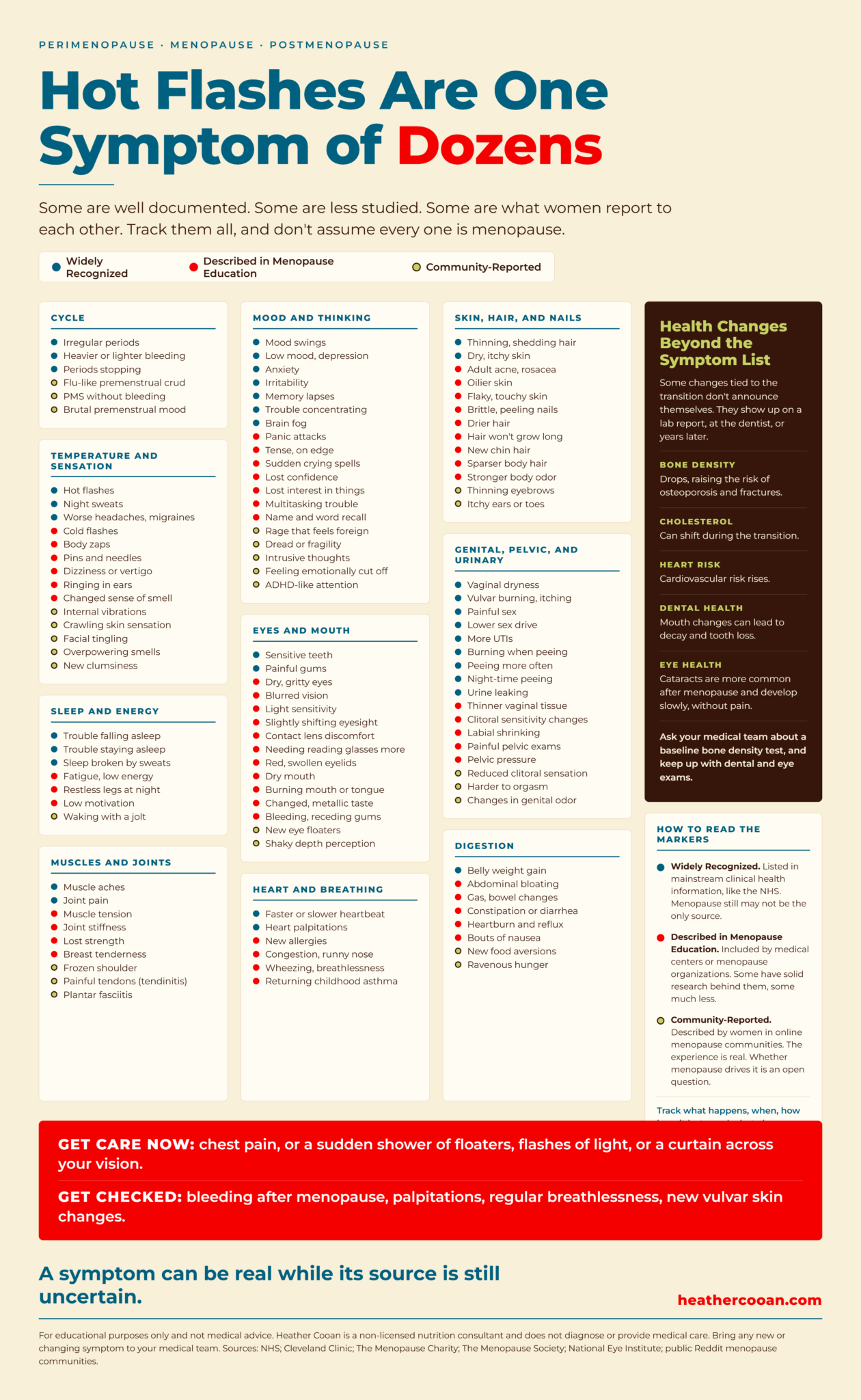
Widely Recognized Symptoms
Periods. Your periods come more or less often, bleed heavier or lighter, and eventually stop.1
Hot flashes and night sweats. Sudden heat in your face, neck, and chest. The NHS notes these can also feel cold, and they can bring heavy sweating, palpitations, anxiety, or dizziness. They hit day or night and last several minutes.1
Sleep. Trouble falling asleep, staying asleep, or both. Night sweats pile on.1
Mood and thinking. Mood swings, low mood, depression, anxiety, irritability, memory lapses, trouble concentrating, and brain fog. All of it gets louder when you're short on sleep.1
Weight. Weight gain, often around the belly and upper body.1
Vaginal and vulvar changes. Dryness, burning, irritation, or itching in and around the vagina, which can make sex painful.1
Urinary changes. More UTIs or UTI-like symptoms, burning when you pee, needing to go more often (including at night), and leaking.1
Heart. A faster, slower, or more noticeable heartbeat.1
Head. Headaches and migraines that are worse than usual.1
Muscles and joints. Aches and pains.1
Hair and skin. Thinning or shedding hair, and dry, itchy skin.1
Libido. A lower sex drive.1
Mouth. Sensitive teeth, painful gums, and other mouth problems.1
Described in Menopause Education, Evidence Varies
This is where most of the "wait, that's connected?" material lives.
Energy. Fatigue and a deep lack of energy that make it harder to get through the day. Broken sleep makes it worse.4,5
Temperature and sensation. Cold flashes, sometimes right after a hot sweat.5. Brief electric-shock sensations, often called body zaps.4,5 Pins and needles in your hands, feet, arms, or legs.4,5 Dizziness, unsteadiness, faintness, or vertigo.4,5 Ringing or buzzing in your ears.5 A changed sense of smell.5 Restless, jumpy legs at night.5
Mood and emotional experience. Panic attacks, sometimes for the first time.4,5 Feeling tense or on edge.5 Crying spells out of nowhere, like during a news story or a TV show.5. Lost confidence, lower self-esteem, low motivation, and losing interest in things that used to light you up.5
Thinking. Trouble multitasking, staying focused on routine tasks, or recalling names and details.5
Digestion. Bloating.4,5 Gas and changes in bowel habits.5 Constipation or diarrhea.4 Heartburn and reflux.4,5 Nausea.5
Skin, hair, nails, and odor. Adult acne, sometimes with rosacea.4 Oilier skin.5 Scaly, flaky, stinging, or touchier skin.4 Brittle nails that crack, split, or peel.4,5 Drier hair, hair that won't grow as long, new chin hair, and sparser hair on your arms, legs, and pubic area.4. Stronger body odor.4
Eyes. Dry, scratchy, or gritty eyes; blurred vision; light sensitivity; and red or swollen eyelids. 4. Eyesight that shifts slightly; contact lenses that suddenly feel uncomfortable; and needing reading glasses more.6. Reading glasses also come with age, which is a good reminder that showing up during menopause and being driven by menopause are two different things.
Mouth. Dry mouth.5 Burning or tingling in your mouth or on your tongue.4,5 A changed or metallic taste.5 Bleeding or receding gums.5
Breasts, muscles, and joints. Breast tenderness.4,5 Muscle tension.4 Joint stiffness and lost strength.5
Genital and pelvic changes. Thinner, less elastic vaginal tissue, tightness, clitoral discomfort or changes in sensitivity, labial shrinking, and pelvic exams or Pap smears that suddenly hurt.5 Pelvic pressure or heaviness, which needs a medical look.5
Breathing and allergy-like symptoms. New or worsening allergies, congestion, and a runny nose.4 Wheezing, breathlessness, or childhood asthma coming back. The Menopause Charity says to get regular breathlessness checked to rule out other causes.5
What Women Report to Each Other
These descriptions are paraphrased from public Reddit threads. I'm not using usernames or quoting anyone directly. They're examples of what women describe living with. This isn't a survey, a prevalence estimate, or proof that menopause is behind any of it.
Women describe internal vibrations, a buzzing inside while the body looks perfectly still. Some wake with an internal jolt.7
They describe skin that feels like bugs crawling on it, itching in weird, isolated places like ears or toes, clumsiness, and depth perception that makes driving feel less sure.8 Others report tingling in the face and new eye floaters.9 If floaters arrive suddenly or with flashes of light, skip ahead to the red flags below.
They describe overpowering smells, changes in genital odor, and new food aversions.8 Others describe hunger that feels ravenous, flu-like crud before an expected period, full PMS with no bleed, and premenstrual mood symptoms that go from bad to brutal.10
They describe rage that doesn't feel like their own and feeling emotionally cut off from people they love. Some say their attention problems feel like ADHD.11 Others describe a new sense of dread or fragility and unwanted intrusive thoughts.12
They describe reduced clitoral sensation or trouble reaching orgasm, frozen shoulder, and plantar fasciitis.11 Tendinitis and thinning eyebrows show up in these conversations too.8,10
The internal vibration thread shows exactly why this category gets its own label. In the same conversation, women describe dysautonomia, chronic fatigue syndrome, and long COVID.7 Showing up in a menopause community and being produced by menopause are not the same thing.
Health Changes Beyond the Symptom List
Some changes tied to the menopause transition don't announce themselves. They show up on a lab report, at the dentist, or years later.
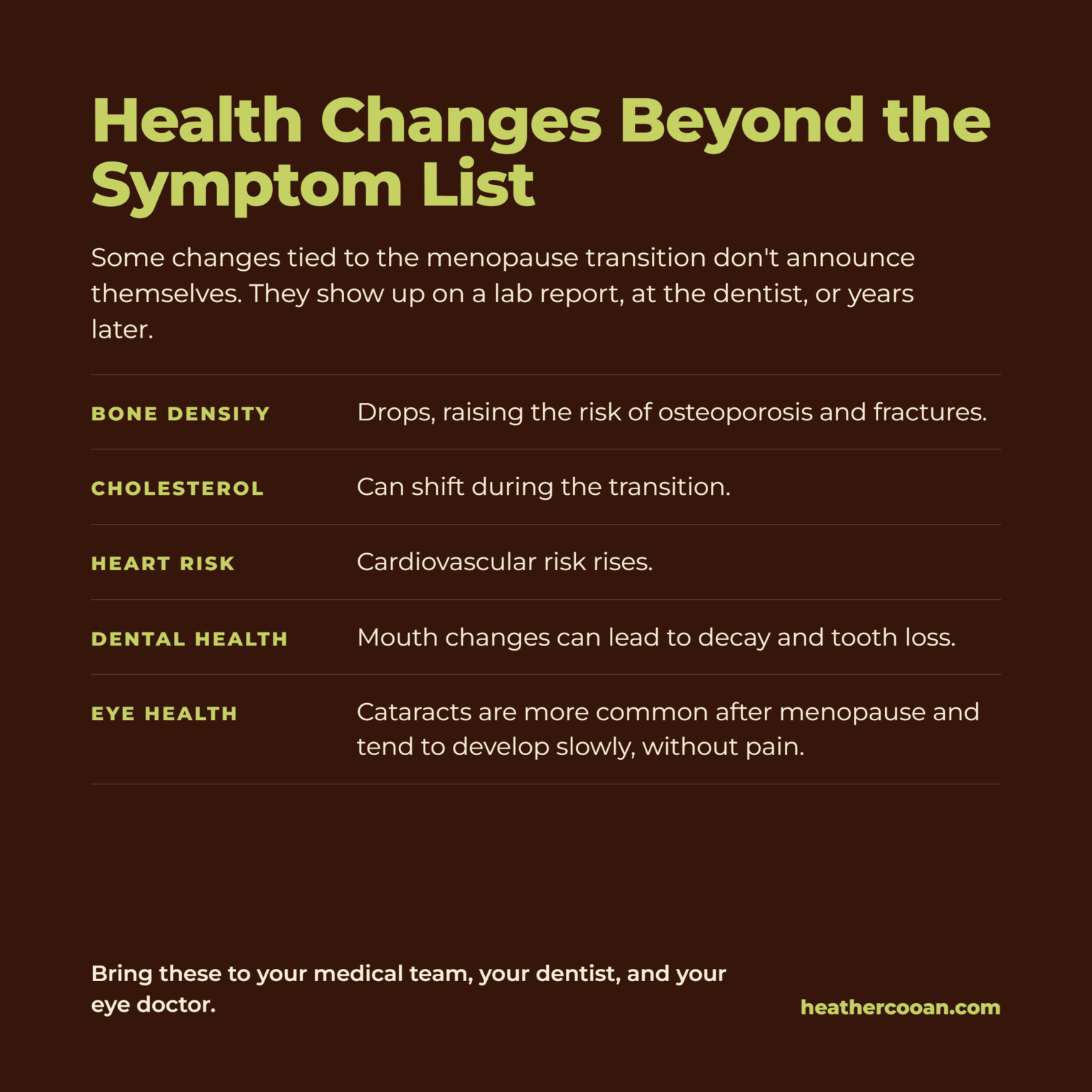
Bone density drops, which raises the risk of osteoporosis and fractures.1,4 Cholesterol can shift, and cardiovascular risk rises.4 Dental decay and tooth loss can follow changes in the mouth.5 Cataracts are more common in postmenopausal women than in men the same age, and they tend to develop slowly and painlessly, often after 60.6
Discuss these with your medical team, your dentist, and your eye doctor. Cleveland Clinic suggests asking your provider about a baseline bone density test as menopause approaches.4
When It Isn't Menopause, or Isn't Only Menopause
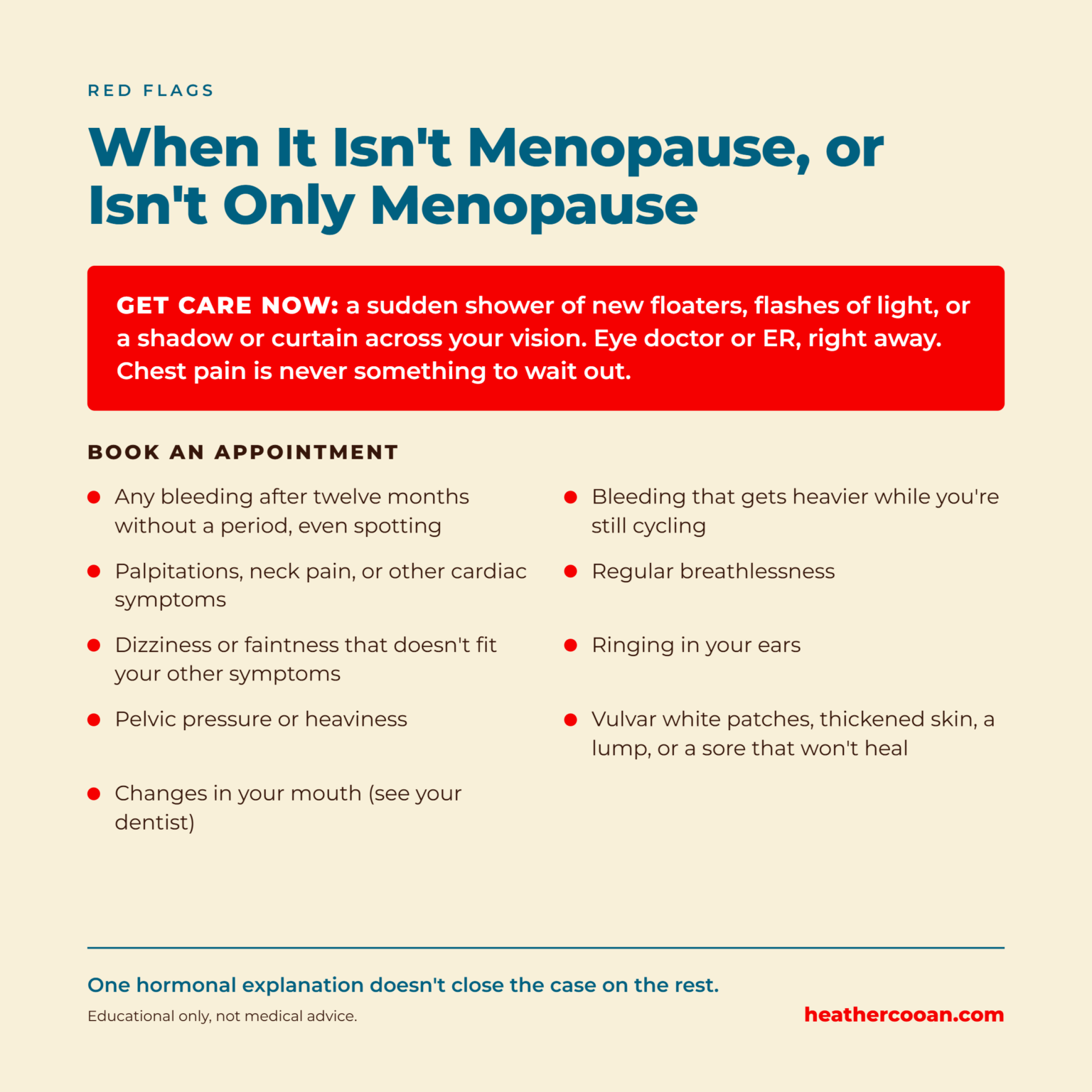
Some symptoms need eyes on them no matter how neatly they fit the menopause story. A few can't wait.
Get care now. A sudden shower of new floaters, flashes of light, or a shadow or curtain across part of your vision is an emergency. See an eye doctor or go to the ER right away.13. Chest pain is never something to wait out.4
Book an appointment. Any vaginal bleeding after twelve months without a period needs to be checked, even if it happened once, and even if it was only spotting or pink or brown discharge.1 While you're still cycling, bleeding that gets heavier rather than lighter is worth a call to your doctor.1 So are palpitations.1 Cleveland Clinic's menopause specialist is blunt about it: never ignore cardiac symptoms, neck pain, chest pain, or palpitations.4 Regular breathlessness, dizziness or faintness that doesn't fit your other symptoms, ringing in your ears, and pelvic pressure all deserve a medical look.5 Changes in your mouth go to your dentist.5
Vulvar symptoms get their own line from me. Dryness, itching, and burning can come from menopause-related tissue changes.1. They can also come from other conditions, including lichen sclerosus, which shows up as itchy white patches and fragile skin that bleeds or hurts when rubbed, and can shrink or tighten the vulva. It's much more common in women over 50, right in the menopause window. It also slightly raises the risk of genital cancer, so a white patch, thickened skin, a lump, or a sore that won't heal needs an exam, not a shrug.14
You already know about my 25 years. That history is why I won't let "common" become shorthand for "nothing else to look at."
Finding a hormonal explanation for one symptom doesn't close the case on the rest. Menopause can sit right alongside something else.
Biography Becomes Biology
Hormonal shifts are real physiology. They also land on a body that's already carrying whatever it's carrying: work, caregiving, illness, grief, old trauma, and decades of pushing through. Researchers call the cumulative wear and tear of chronic stress allostatic load,15 and the transition doesn't wait for that load to clear before showing up.
The NHS describes a loop most of us recognize. Poor sleep leaves you irritable, stressed, and anxious, and mood and memory symptoms hit harder when you're exhausted.1 Night sweats break your sleep, and broken sleep drops your threshold for everything else. Cleveland Clinic specialists call it a cascade.4
Usage Capacity™ is the lens I use to figure out what you can realistically take on right now. If you're sleeping badly, caregiving, and barely getting through the day, a plan that piles on more demands is the wrong plan, no matter how good every recommendation looks on paper. I don't know what it is about women, but we all seem to take on everybody else's crap and put ourselves last. The number of women that I see on a daily basis who are filling up all of their capacity with everyone else's crap is incredible. Boundaries are a good place to start. Girl, you're worth it, and you should start acting like it.
Your body did not fail. It adapted. Your symptoms are real, and they aren't a character flaw. Looking at the whole terrain gives you more places to look, alongside your medical team and never in place of them.
Bring This to Your Appointment
Track what you notice: what happens, when, how long it lasts, and what else was going on that day. The Menopause Charity has a free symptom tracker built for exactly this.5. Bring the record with you. Patterns are easier to see on paper than from memory, especially when brain fog has a seat in the exam room.
Decisions about hormone therapy and other medical options belong to you and your prescribing clinician. If you have a history of hormone-sensitive cancer, your oncology team needs to be in that conversation.
You're the expert on your body. My role is education and the daily-life side of this work: finding where your load is coming from and building habits that fit the capacity you actually have right now, not the capacity you had at 35.
Living with cancer, autoimmunity, or complex chronic illness? Check out these success stories from clients who addressed the root-cause contributors that were disrupting their terrain, leaving them vulnerable to disease, and are now thriving!
This information is for educational purposes only and is not medical advice. Heather Cooan is a non-licensed nutrition consultant and does not diagnose or provide medical care. Always consult your physician before changing your healthcare plan.
FAQs
Perimenopause is the transition: the years when hormones fluctuate, and symptoms usually start. Menopause is your final period, confirmed once you've gone twelve months without one. Everything after that is postmenopause, and symptoms can show up in any of the three stages.
Most women reach menopause between 45 and 55. Perimenopause starts earlier, which is why symptoms can show up years before your periods stop. Menopause before 45 is considered early. Surgery or cancer treatment can bring it on much sooner.
Usually a change in your periods. They come more or less often, and bleeding gets heavier or lighter. Hot flashes, night sweats, trouble sleeping, mood swings, and brain fog often show up around the same time.
Usually 7 to 9 years, sometimes longer, and they change along the way. Hot flashes might ease right as low mood or anxiety moves in. Some symptoms, like joint pain and vaginal dryness, can keep going after menopause.
It depends on who's counting. The National Menopause Foundation lists 36, and The Menopause Charity says over 34. Counts swing based on how a list splits things up. Insomnia, difficulty sleeping, and sleep disturbance can be three entries or one miserable night. The range matters more than the number.
Yes. Anxiety, mood swings, low mood, and irritability are all recognized perimenopause and menopause symptoms, and some women have panic attacks for the first time. Poor sleep makes it all feel louder. If anxiety is new or getting worse in your 40s, tell your medical team where you are in the transition.
Body zaps, which are brief electric-shock sensations, plus burning mouth, ringing in the ears, a metallic taste, new allergies, brittle nails, changes in body odor, and restless legs. These symptoms appear in menopause education resources. Women online also describe internal vibrations and skin that feels like bugs crawling on it.
Yes. Dry, gritty, or scratchy eyes, blurred vision, light sensitivity, and contact lenses that suddenly feel uncomfortable are all linked to the transition. One exception matters: a sudden shower of new floaters, flashes of light, or a shadow across your vision is an emergency. See an eye doctor or go to the ER right away.
Yes. Your periods may be irregular, but you can still ovulate. NHS guidance is to keep using contraception for two years after your last period if you're between 40 and 49, and for one year if you're 50 or older. Hormonal birth control can also hide the period changes that signal perimenopause.
No. Any vaginal bleeding after twelve months without a period needs to be checked. That includes bleeding that happened only once and bleeding that was just spotting or pink or brown discharge. It's usually not serious, but it can be a sign of cancer, so don't wait it out.
Often you can't tell on your own. Many menopause symptoms overlap with other conditions, and finding a hormonal explanation for one symptom doesn't explain the rest. Track what you notice, when it happens, and how long it lasts. Then bring that record to your medical team so they can look at what else might be going on.
It's menopause brought on by surgery that removes both ovaries. Hormones drop all at once instead of tapering, so symptoms can start right after surgery and may be more severe than with natural menopause. Some chemotherapy, pelvic radiation, and hormone therapies can also bring on early menopause.
Unanswered Questions?
Ask AI for Answers Based On This Post
References:
- NHS. Symptoms of menopause and perimenopause. NHS website. Reviewed May 19, 2026. Accessed October 7, 2026. https://www.nhs.uk/conditions/menopause-and-perimenopause/symptoms/
- National Cancer Institute. Female fertility and cancer treatment. National Cancer Institute. Updated May 14, 2025. Accessed October 7, 2026. https://www.cancer.gov/about-cancer/treatment/side-effects/fertility-women
- Cleveland Clinic. Do you go through menopause after a hysterectomy? Cleveland Clinic Health Essentials. February 5, 2025. Accessed October 7, 2026. https://health.clevelandclinic.org/menopause-after-hysterectomy
- Cleveland Clinic. 29 perimenopause symptoms you may not know about. Cleveland Clinic Health Essentials. July 14, 2025. Accessed October 7, 2026. https://health.clevelandclinic.org/weird-symptoms-of-low-estrogen
- The Menopause Charity. Join the dots: A-Z symptoms list. The Menopause Charity. Updated January 2024. Accessed October 7, 2026. https://themenopausecharity.org/information-and-support/symptoms/join-the-dots-a-z-symptoms-list/
- The Menopause Society. Menopause and eye health. The Menopause Society. Accessed October 7, 2026. https://menopause.org/for-women/menopauseflashes/women's-health-and-menopause/menopause-and-eye-health
- What's the name of the condition where you wake up and your nervous system is vibrating? Online forum discussion. r/Perimenopause. Reddit. December 6, 2025. Accessed October 7, 2026. https://www.reddit.com/r/Perimenopause/comments/1pfj3cx/whats_the_name_of_the_condition_where_you_wake_up/
- What are some of the weirdest things you've discovered in perimenopause and menopause as you lost estrogen? Online forum discussion. r/Menopause. Reddit. April 24, 2024. Accessed October 7, 2026. https://www.reddit.com/r/Menopause/comments/1cbluoq/what_are_some_of_the_weirdest_things_youve/
- What crazy symptoms do you have? Please share. Online forum discussion. r/Perimenopause. Reddit. February 27, 2026. Accessed October 7, 2026. https://www.reddit.com/r/Perimenopause/comments/1rg3wir/what_crazy_symptoms_do_you_have_please_share/
- Weirdest symptoms of menopause? Online forum discussion. r/GenXWomen. Reddit. September 9, 2024. Accessed October 7, 2026. https://www.reddit.com/r/GenXWomen/comments/1fclnl1/weirdest_symptoms_of_menopause/
- What was your worst symptom of menopause? Was it "hot flashes" or something else? Online forum discussion. r/Menopause. Reddit. November 23, 2025. Accessed October 7, 2026. https://www.reddit.com/r/Menopause/comments/1p4gji1/what_was_your_worst_symptom_of_menopause_was_it/
- Other awful symptoms? Online forum discussion. r/Menopause. Reddit. April 20, 2025. Accessed October 7, 2026. https://www.reddit.com/r/Menopause/comments/1k3cjb5/other_awful_symptoms/
- National Eye Institute. Retinal detachment. National Eye Institute. Updated November 5, 2025. Accessed October 7, 2026. https://www.nei.nih.gov/eye-health-information/eye-conditions-and-diseases/retinal-detachment
- NHS. Lichen sclerosus. NHS website. Reviewed December 9, 2024. Accessed October 7, 2026. https://www.nhs.uk/conditions/lichen-sclerosus/
- McEwen BS. Stress, adaptation, and disease: allostasis and allostatic load. Ann N Y Acad Sci. 1998;840(1):33-44. doi:10.1111/j.1749-6632.1998.tb09546.x




Comments
No Comments