

Content Note: This post discusses CPTSD, compulsive eating, binge eating, food addiction, cravings, and recovery.
I knew which foods made me feel unwell. I knew I would regret the binge. I knew that stopping would make me feel better… eventually. And still, I would find myself back in the same loop.
QUICK REFERENCE
- I didn't think this applied to me
- Food as coping
- My food-coping cycle
- Stress, endorphins, and relief
- Why manufactured foods can feel different
- The withdrawal-like period
- Casein, gluten, and opioid-active peptides
- Food sobriety is part of my healing
- Where healing interrupts the cycle
- You are not broken
- FAQs
- Unanswered Questions?
- Discussion
What I understand now is that, for me, the loop often does not begin with hunger.
It begins with an emotional flashback.
I live with complex post-traumatic stress disorder, or CPTSD. An emotional flashback is not necessarily a visual replay of a past event. It can be a sudden, body-level experience of shame, fear, urgency, loneliness, helplessness, overwhelm, or danger. My adult mind may know I am safe, but my nervous system responds as if something old is happening again.
In that state, food can become a fast and familiar route to relief.
Not a moral failure. A nervous-system survival strategy that has become costly.
I didn't think this applied to me
For a long time, I would have told you food addiction was not my story.
When I was diagnosed with cancer, I dropped into a strict therapeutic ketogenic diet: sugar-free, dairy-free, grain-free, and gluten-free. I held that diet for two to three years and read my own discipline as proof that I wasn't an emotional eater; I didn't have a problem with food.
That wasn't discipline...it was circumstance.
Diagnosis had quietly stripped most ordinary stress from my life. I quit my high-pressure job to dedicate myself to addressing my health, and obligations fell away. Without realizing it, I had deleted stress and built a bubble that functioned like a retreat, every condition controlled, every variable accounted for. That looked like healing. It was closer to a controlled environment than to coping skills I had actually built.
Then my husband lost his job during the pandemic, and I went back into marketing work to bring in cash. The stress came back fast, and the old habits came back with it.
That's when I learned I didn't have coping skills. I hadn't even known they were missing, because I had never been tested without the bubble.
Even then, I didn't yet understand that food was part of it. I've always struggled with my weight, and for years I treated that as a separate issue. It turns out to be more complex than that. Food is not just food in my life. It plays a much bigger role than that, and I couldn't see how much until I got rid of everything else.
For years, a dysfunctional relationship with food was buried under working too much, running too hard, overachieving, and living in survival mode. Once I stripped that away, how I used food was the piece left standing.
I've learned a lot since then. Building the cycle below came out of that whole unraveling.
Food as coping
For me, highly processed food, fast food, restaurant food, and certain dairy- and gluten-containing foods can become much more than food.
They can become comfort. Numbing. Distraction. Reward. A way to disconnect from my body. A way to change how I feel quickly enough to get through the next moment.
The relief is real… but temporary.
Then comes the familiar fallout: physical discomfort, cravings, shame, preoccupation, withdrawal-like symptoms when I stop, and the exhaustion of trying to get back to myself again.
Research supports a meaningful association between post-traumatic stress symptoms, emotion-regulation difficulties, emotional eating, and binge-eating problems. In one study, greater post-traumatic stress symptom severity was associated with more severe binge eating through increased emotion-regulation difficulties and emotional eating.1
That finding resonates deeply with me. It does not mean every episode of overeating is a trauma response, nor does it explain every person's relationship with food. But it helps illuminate why generic advice like "just stop," "use more discipline," or "make better choices" can miss the point.
When the nervous system is in survival mode, immediate relief can feel like a need, not a preference.
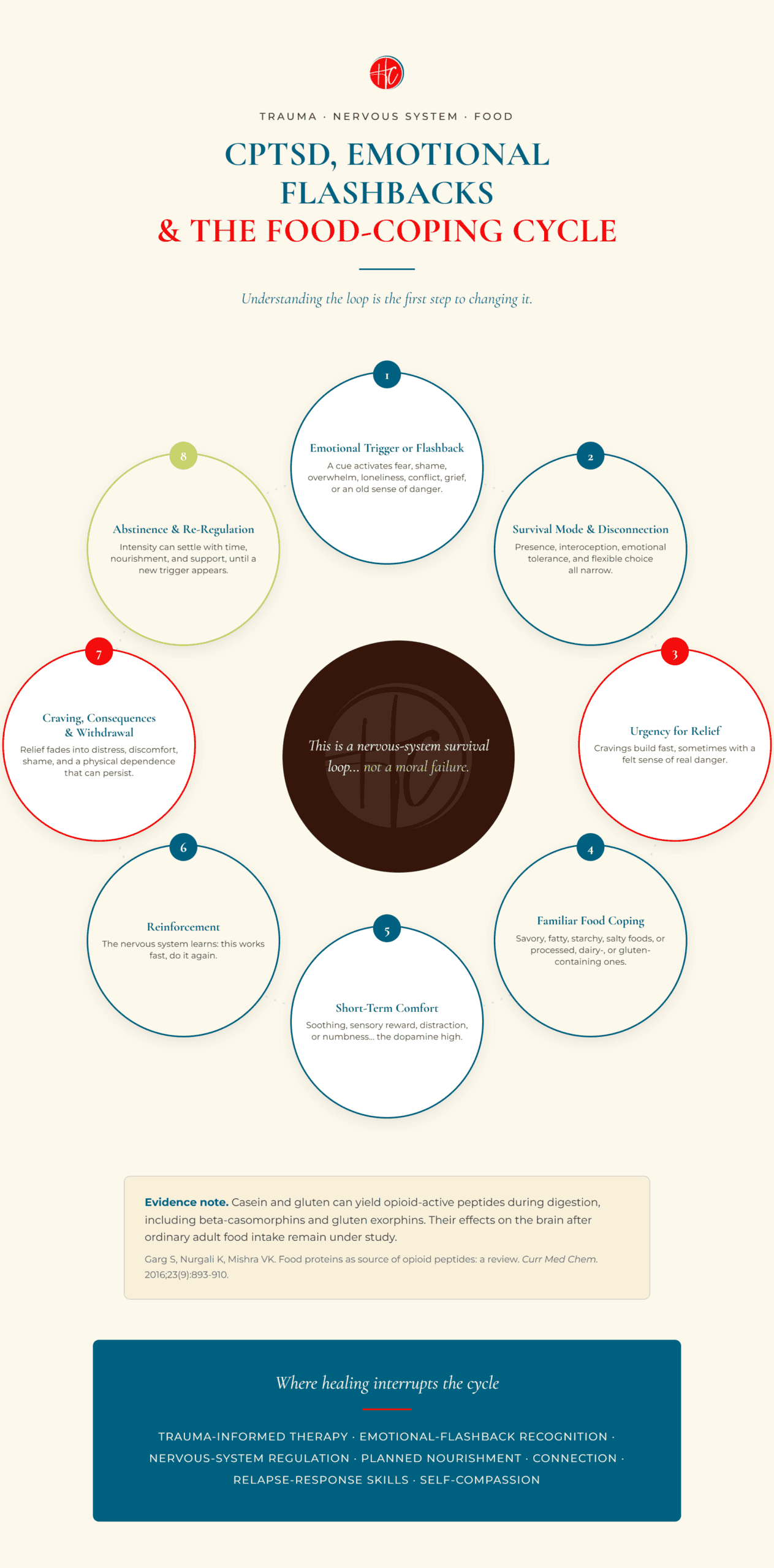
My food-coping cycle
This is the cycle I have come to recognize in myself:
- Emotional trigger or flashback. A cue activates fear, shame, overwhelm, loneliness, exhaustion, conflict, perceived rejection, grief, or an old sense of danger.
- Survival mode and disconnection. I become less able to remain present with what I feel. My capacity for interoception, emotional tolerance, and flexible choice narrows.
- Urgency for relief. Cravings, preoccupation, and the feeling that I need something now begin to build. Sometimes it feels like I will die or am in serious danger if I don't satisfy this need.
- Familiar food coping. I seek the foods that have historically offered the fastest relief, often manufactured, restaurant, fast, dairy-containing, and gluten-containing foods. I've heard others describe this with sugar and sweets, but for me, it's savory foods high in fat, starch, and salt.
- Short-term comfort. There may be a temporary experience of soothing, sensory reward, predictability, distraction, fullness, comfort, or numbness. I think this is dopamine...the high.
- Reinforcement. My nervous system learns again: this works quickly; do this the next time you feel this way.
- Cravings, consequences, and withdrawal-like symptoms. The temporary relief fades. I may experience renewed distress, cravings, physical discomfort, fatigue, irritability, shame, and a strong pull toward the same foods. The physical dependence...this is where I can get stuck for a prolonged period of time and can really damage my health.
- Abstinence and re-regulation. When I stop, there is a period I call "drying out." With time, nourishment, support, and nervous-system regulation, the intensity can settle until another trigger creates vulnerability to restarting the loop.
Seeing the cycle has changed the questions I ask myself. Instead of asking, "Why can't I just stop?" I try to ask: "What happened in my nervous system before I needed relief?"
That question creates space for curiosity where shame used to take over.
Stress, endorphins, and relief
The body's own opioid system adds another layer here.
The endogenous opioid system includes signaling molecules such as endorphins, enkephalins, dynorphins, and endomorphins. It participates in pain regulation, reward, motivation, stress response, and emotional experience. Stress can influence this system, and eating can engage it as well. 2-4
Food isn't equivalent to an opioid drug. But eating, and especially the anticipatory and rewarding aspects of palatable food, can engage some of the same brain systems involved in reward and relief.
Human imaging research has demonstrated widespread endogenous opioid release in the brain after feeding. In that study, the release occurred after both palatable and nonpalatable meals and was not explained solely by reported pleasure, suggesting that feeding-related opioid signaling has metabolic and homeostatic roles in addition to hedonic ones. 3
Research on binge eating also implicates endogenous opioid signaling in the rewarding and anticipatory processes around highly palatable food.4 The opioid system may be involved not only in the "this tastes good" experience, but in the escalating pull of wanting, seeking, and expecting relief from food.
For someone living with trauma-related stress reactivity, this matters. An emotional flashback can generate fear, shame, dysphoria, urgency, or disconnection. In that moment, the nervous system may not be seeking pleasure as much as it is seeking escape from distress.
This is where the concept of negative reinforcement becomes useful. Negative reinforcement does not mean "bad" reinforcement. It means that a behavior becomes more likely because it temporarily reduces an aversive internal state.
If highly palatable food quickly softens distress, creates numbness, or produces temporary relief, the nervous system can learn to seek it again whenever a similar internal state appears. Chronic stress has been linked to "comfort food" patterns and stress-related changes in eating behavior, although the underlying mechanisms are complex and extend beyond any one neurotransmitter system. 2
None of this means an emotional flashback causes an "endorphin deficiency," or reduces trauma and compulsive eating to a single neurochemical explanation. It's one component of a much larger picture that includes trauma learning, conditioning, reward pathways, stress physiology, environment, food reactivity, nourishment, and access to coping skills.
For me, this understanding replaces shame with a better question: "What is my nervous system trying to escape, and what else could help me move through it safely?"
Why manufactured foods can feel different
I do not believe all food is addictive, and I do not assume my experience is universal. But emerging research on addictive-like eating focuses primarily on highly processed foods rather than food as a whole. 5
Highly processed foods are often designed for intense reward and rapid consumption. They can combine refined carbohydrate, fat, salt, flavorings, texture, and convenience in ways that may be especially difficult for some people to moderate, particularly people with a history of binge eating, emotion-driven eating, trauma-related dysregulation, or compulsive food patterns.
The Yale Food Addiction Scale was developed to assess addictive-like eating using symptoms modeled after substance-use-disorder criteria. These include cravings, unsuccessful efforts to reduce use, continued use despite negative consequences, and clinically significant distress or impairment. 6 It is a research tool, not a standalone diagnosis, but it has helped give language to a pattern many people recognize in themselves.
The evidence does not say that everyone who consumes highly processed foods becomes addicted. It does suggest that some highly processed foods can produce addiction-like responses in a subset of people. 5-7
For me, that distinction matters. I am not at war with food. I am learning to recognize the specific foods and patterns that repeatedly compromise my health, agency, and peace.
The withdrawal-like period
When I stop eating foods that trigger this cycle, it does not feel like a neutral dietary adjustment.
I often experience what I call a "drying out" period: intense cravings, agitation, fatigue, emotional intensity, discomfort, preoccupation, and a strong urge to relieve the discomfort with the same foods that created it.
Sometimes I can interrupt the cycle within days. Other times, I have remained in it for weeks or months before I can regain enough stability and traction to stop.
Research is beginning to take these experiences seriously. The Highly Processed Food Withdrawal Scale was developed to assess physical, cognitive, and psychological symptoms reported after reducing highly processed foods. These symptoms include cravings, irritability, headaches, fatigue, and difficulty concentrating. 8
Food withdrawal isn't medically identical to withdrawal from alcohol, benzodiazepines, opioids, or other substances with potentially dangerous withdrawal syndromes. It does mean withdrawal-like symptoms following reductions in highly processed foods have been described, measured, and studied.
For now, "withdrawal-like" is the language that most honestly respects both the research and my lived experience.
Casein, gluten, and opioid-active peptides
I am especially reactive to casein, whey, and gluten, and I have long experienced dairy- and gluten-containing foods as particularly hard to leave behind once I am in the cycle.
Food-derived opioid peptides have a legitimate biochemical basis worth discussing. During digestion or food processing, beta-casein can yield beta-casomorphins, and wheat proteins can yield opioid-active peptides commonly called gluten exorphins, gluteomorphins, or gliadorphins. 9 Beta-casomorphin-7 is one of the best-known examples and shows opioid-receptor agonist activity in experimental systems, including activity at the μ-opioid receptor. 9,10
However, scientific accuracy matters here. The evidence is stronger for the formation of these peptides and for their opioid activity in experimental models than it is for claims about their effects after ordinary food intake in adults. Their intestinal absorption, persistence in circulation, transport across the adult blood-brain barrier, and clinically meaningful effects on the central nervous system remain under investigation.9,10
So I do not claim that every person who consumes dairy or gluten is experiencing an opioid effect, nor do I claim that routine exposure produces medically equivalent opioid dependence or withdrawal.
I can still honor what is true for me: certain foods create a disproportionate compulsive pull, amplify my food-coping cycle, and cause significant physical consequences. The biology may be multifactorial: food sensitivity or reactivity, gut and immune factors, reward learning, trauma-state conditioning, blood sugar and stress physiology, hyperpalatability, and potentially food-derived peptide activity.
I do not need one perfect explanation in order to take the pattern seriously.
Food sobriety is part of my healing
I use the phrase food sobriety intentionally and carefully.
Food is not alcohol. We need nourishment to live. Restriction, food fear, and dietary perfectionism can be harmful, and they can become their own form of disordered eating.
For me, food sobriety does not mean eating perfectly or fearing all enjoyable food. It means seeking freedom from the specific foods and compulsive patterns that repeatedly take away my agency.
It means stepping out of the loop of emotional flashback, food as anesthesia, temporary relief, physical and emotional fallout, shame, and more food to escape the shame. It means choosing nourishment, not punishment. It means building a life in which food is not my only available regulator when I am hurting.
Where healing interrupts the cycle
Healing is not linear, and it is not solved through willpower alone. For me, it involves learning to recognize the emotional flashback earlier and creating more options before I reach the point of urgency.
The practices that help me interrupt the cycle include:
- Trauma-informed therapy and emotional processing
- Recognizing emotional flashbacks and survival-state patterns
- Nervous-system regulation practices
- Planned, adequate nourishment rather than deprivation
- Reducing access to the foods that reliably fuel my cycle
- Connection instead of isolation
- Rest, hydration, movement, and predictable routines
- A relapse-response plan that replaces shame with curiosity and care
- Self-compassion paired with real accountability
People with trauma histories can benefit from eating-disorder treatment, although traumatic-event exposure and PTSD symptoms may increase treatment dropout risk or risk of symptom relapse for some individuals. 11
Eating-disorder-focused psychotherapy is recommended in the American Psychiatric Association's current guideline for conditions including binge-eating disorder. 12
The answer isn't "try harder." The answer is support that addresses both the behavior and the pain beneath it.
You are not broken
If food has become a way to soothe, numb, disappear, quiet panic, quiet shame, or survive an emotional flashback, you are not weak, and you are not alone.
The pattern may be costly. It may be harming your health, relationships, peace, and sense of agency. But it likely developed for a reason.
My goal is not perfection. It is to understand the loop sooner, respond with more compassion, build skills that expand my choices, and return to myself more quickly when I lose my way.
Food sobriety has become a major component of my healing, not because I need more rules, but because I want more freedom.
Disclaimer: This post reflects my personal experience and is provided for education only. It is not medical, nutrition, mental-health, or eating-disorder treatment advice. If you are experiencing binge eating, recurrent vomiting, purging, food restriction, self-harm, suicidal thoughts, or difficulty meeting basic nutritional needs, please seek support from an appropriately qualified medical, mental-health, trauma-informed, or eating-disorder-informed clinician.
Living with cancer, autoimmunity, or complex chronic illness? Check out these success stories from clients who addressed the root-cause contributors that were disrupting their terrain, leaving them vulnerable to disease, and are now thriving!
FAQs
A food-coping cycle is a recurring pattern in which an emotional trigger-such as stress, shame, loneliness, overwhelm, or an emotional flashback-creates urgency for relief. A person then uses food, often highly processed or personally triggering foods, to soothe, numb, distract, or regulate the feeling. The relief is temporary, which can reinforce the behavior and lead to cravings, distress, or another episode later.
It can. An emotional flashback may create an intense body-level state of fear, shame, danger, or urgency even when a person logically knows they are safe. Research links greater post-traumatic stress symptoms with emotion-regulation difficulties, emotional eating, and binge-eating problems.1
Not every episode of overeating is caused by trauma, but trauma-related stress can make fast relief feel urgent and can reduce access to coping strategies in the moment.
Not necessarily. Emotional eating means using food to manage or change an emotional state rather than eating primarily from physical hunger. "Food addiction" or "addictive-like eating" describes a more specific pattern that may include intense cravings, repeated unsuccessful efforts to cut down, continued use despite negative consequences, and significant distress or impairment.
Researchers often use the Yale Food Addiction Scale to study addictive-like eating. It is a research tool and does not replace an individualized medical or mental-health assessment.2
Highly processed foods can be engineered for intense reward, convenience, rapid consumption, and repeated use. Many combine refined carbohydrates, fats, salt, flavorings, and highly reinforcing textures. Research on addictive-like eating focuses primarily on highly processed foods rather than all foods.3
For some people, these foods can become closely linked to emotional relief, environmental cues, habit, reward learning, and stress regulation. That does not mean every person who eats highly processed food is "addicted," but it helps explain why certain foods can feel disproportionately difficult to moderate.
Yes. Stress can change eating behavior and increase the appeal of highly palatable "comfort" foods for some people. Food can briefly reduce distress, create sensory comfort, or provide a predictable reward. When that relief follows stress repeatedly, the nervous system can learn to seek the same food during future distress.4
This is called negative reinforcement: a behavior becomes more likely because it temporarily reduces an unpleasant internal state. It does not mean the person is weak, lazy, or lacking knowledge.
Endorphins are part of the body's endogenous opioid system, along with other signaling molecules such as enkephalins and dynorphins. This system participates in pain regulation, stress response, reward, motivation, and emotional experience.
Eating can engage endogenous opioid signaling in the brain. Human imaging research has found endogenous opioid release after feeding, and research on binge-type eating identifies opioid signaling as relevant to reward and anticipatory "wanting" around food.5,6
This does not mean food is identical to an opioid drug or that someone has an "endorphin deficiency." It means food, stress, relief, reward learning, and craving can overlap in some of the same biological systems.
Some people report withdrawal-like symptoms when they reduce highly processed foods, including cravings, irritability, fatigue, headaches, low mood, and trouble concentrating. The Highly Processed Food Withdrawal Scale was developed to measure these physical, cognitive, and psychological experiences.7
This research does not establish that stopping highly processed food produces the same medical withdrawal syndrome as alcohol, benzodiazepines, or opioids. "Withdrawal-like" is the more accurate term, and severe or persistent symptoms should be discussed with a qualified clinician.
Casein and wheat proteins can yield food-derived peptides with opioid activity during digestion or food processing. Beta-casein can yield beta-casomorphins, while wheat proteins can yield peptides referred to as gluten exorphins, gluteomorphins, or gliadorphins.8
However, the existence of these peptides does not prove that ordinary consumption of dairy or gluten causes opioid-like dependence or withdrawal in adults. Their absorption, persistence, transport across the adult blood-brain barrier, and clinically meaningful brain effects remain under investigation.8,9
No. Current evidence does not support the claim that dairy or gluten are universally addictive or that everyone experiences opioid-like effects from them. Individual experiences can vary because of food allergy, celiac disease, non-celiac wheat sensitivity, lactose intolerance, other digestive or immune factors, reward learning, sensory preference, and trauma-linked coping patterns.
If dairy or gluten reproducibly cause symptoms for you, discuss an individualized evaluation with an appropriately qualified medical clinician or dietitian. Do not self-diagnose celiac disease after starting a gluten-free diet, since testing can be affected by gluten avoidance.
Food sobriety is personal language, not a formal medical diagnosis. In this context, it means seeking freedom from the specific foods and compulsive patterns that repeatedly lead to loss of agency, distress, and harm.
It does not have to mean fearing all food, eating perfectly, or embracing rigid restriction. A trauma-informed approach emphasizes adequate nourishment, flexibility, support, self-compassion, and practical relapse-response skills.
Start with safety and curiosity rather than shame. Helpful steps can include:
Pause and name the emotional state: "I may be triggered, overwhelmed, or in an emotional flashback."
Eat planned, adequate meals and snacks rather than trying to compensate through deprivation.
Reduce access to foods that reliably fuel your personal compulsive cycle.
Use a brief regulation practice: paced breathing, grounding, a shower, movement, sensory support, or contacting someone safe.
Create a written plan for high-risk moments before they occur.
Seek trauma-informed and eating-disorder-informed support when food coping is recurrent, distressing, or affecting health.
The right approach depends on the person. For some people, rigid food rules can worsen binge-restrict cycles, so individualized care matters.
Consider professional support if you feel unable to control eating episodes; food thoughts or cravings consume significant time; eating causes medical symptoms or major distress; you are vomiting, restricting, purging, using laxatives, or engaging in compensatory exercise; or you feel hopeless or unsafe.
A trauma-informed therapist, eating-disorder-informed clinician, registered dietitian, and medical clinician can help address both the food pattern and the underlying distress. Seek urgent or emergency care for vomiting blood, coffee-ground-appearing vomit, severe chest or abdominal pain, fainting, inability to keep fluids down, severe dehydration, or signs of anaphylaxis after food exposure.
Unanswered Questions?
Ask AI for Answers Based On This Post
References:
- Echeverri-Alvarado B, Pickett S, Gildner D. A model of post-traumatic stress symptoms on binge eating through emotion regulation difficulties and emotional eating. Appetite. 2020;150:104659. doi:10.1016/j.appet.2020.104659
- Dallman MF, Pecoraro NC, la Fleur SE. Chronic stress and comfort foods: self-medication and abdominal obesity. Brain Behav Immun. 2005;19(4):275-280. doi:10.1016/j.bbi.2004.11.004
- Tuulari JJ, Tuominen L, de Boer FE, et al. Feeding releases endogenous opioids in humans. J Neurosci. 2017;37(34):8284-8291. doi:10.1523/JNEUROSCI.0976-17.2017
- Giuliano C, Cottone P. The role of the opioid system in binge eating disorder. CNS Spectr. 2015;20(6):537-545. doi:10.1017/S1092852915000413
- Gearhardt AN, DiFeliceantonio AG. Highly processed foods can be considered addictive substances based on established scientific criteria. Addiction. 2023;118(4):589-598. doi:10.1111/add.16065
- Gearhardt AN, Corbin WR, Brownell KD. Development of the Yale Food Addiction Scale version 2.0. Psychol Addict Behav. 2016;30(1):113-121. doi:10.1037/adb0000136
- Penzenstadler L, Soares C, Karila L, Khazaal Y. Systematic review of food addiction as measured with the Yale Food Addiction Scale: implications for the food addiction construct. Curr Neuropharmacol. 2019;17(6):526-538. doi:10.2174/1570159X16666181108082542
- Schulte EM, Smeal JK, Lewis J, Gearhardt AN. Development of the Highly Processed Food Withdrawal Scale. Appetite. 2018;131:148-154. doi:10.1016/j.appet.2018.09.013
- Tyagi A, Daliri EBM, Kwami Ofosu F, Yeon SJ, Oh DH. Food-derived opioid peptides in human health: a review. Int J Mol Sci. 2020;21(22):8825. doi:10.3390/ijms21228825
- Bolat E, et al. BCM-7: opioid-like peptide with potential role in disease mechanisms. Molecules. 2024;29(9):2161. doi:10.3390/molecules29092161
- Convertino AD, Mendoza RR. Post-traumatic stress disorder, traumatic events, and longitudinal eating disorder treatment outcomes: a systematic review. Int J Eat Disord. 2023;56(6):1055-1074. doi:10.1002/eat.23933
- Crone C, Fochtmann LJ, Attia E, et al. The American Psychiatric Association practice guideline for the treatment of patients with eating disorders. Am J Psychiatry. 2023;180(2):167-171. doi:10.1176/appi.ajp.23180001



Comments
No Comments